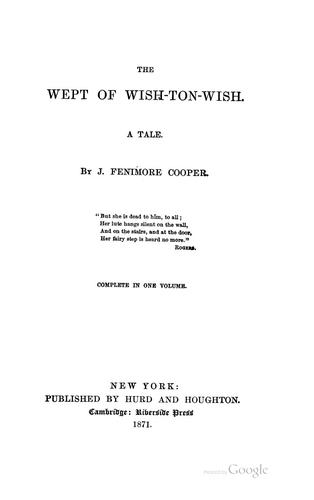
Historical fiction; King Philip's War, 1675-1676 -- Fiction; War stories
Ruth stooped to kiss the cheek that her daughter offered to the salute.
The embrace was then given to the other child, who was in truth scarcely
less near her heart, being the orphan daughter of one who had been as a
sister in her affections. But, unlike the kiss she had impressed on the
forehead of Mark, the present embraces were hasty, and evidently awakened
less intense emotion. She had committed the boy to a known and positive
danger, but, under the semblance of some usefulness, she sent the others
to a place believed to be even less exposed, so long as the enemy could be
kept without the works, than the citadel itself. Still, a feeling of deep
and maternal tenderness came over her mind, as her daughter retired; and,
yielding to its sudden impulse, she recalled the girl to her side.
"Thou wilt repeat the prayer for especial protection against the dangers
of the wilderness," she solemnly continued. "In thy asking, fail not to
remember him to whom thou owest being, and who now exposeth life, that we
may be safe. Thou knowest the Christian's rock; place thy faith on its
foundation."
"And they who seek to kill us," demanded the well-instructed child; "are
they too of the number of those for whom he died?"
"It may not be doubted, though the manner of the dispensation be so
mysterious! Barbarians in their habits, and ruthless in their enmities,
they are creatures of our nature, and equally objects of his care."
Flaxen locks, that half-covered a forehead and face across which ran the
most delicate tracery of veins, added lustre to a skin as spotlessly fair
as if the warm breezes of that latitude had never fanned the countenance
of the girl. Through this maze of ringlets, the child turned her full,
clear, blue eyes, bending her looks, in wonder and in fear, on the dark
visage of the captive Indian youth, who at that moment was to her a
subject of secret horror. Unconscious of the interest he excited, the lad
stood calm, haughty, and seemingly unobservant, cautious to let no sign of
weakness or of concern escape him, in this scene of womanly emotion.
"Mother," whispered the still wondering child; "may we not let him go into
the forest? I do not love to--"
"This is no time for speech. Go to thy hiding-place, my child, and
remember both thy askings and the cautions I have named. Go, and heavenly
care protect thy innocent head!"
Ruth again stooped, and bowing her face until the features were lost in
the rich tresses of her daughter, a moment passed during which there was
an eloquent silence. When she arose, a tear glistened on the cheek of the
child. The latter had received the embrace more in apathy than in concern;
and now, when led towards the upper rooms, she moved from the presence of
her mother, it was with an eye that never bent its riveted gaze from the
features of the young Indian, until the intervening walls hid him entirely
from her sight.
Public-domain text, read in full here on John Shaqi.
Reviews
Reviews
No reviews yet
Be the first to share your thoughts on this work.
Elsewhere in the archive
Join the Discussion
Join the discussion
Sign in to leave a comment or review.
Sign InorCreate an account