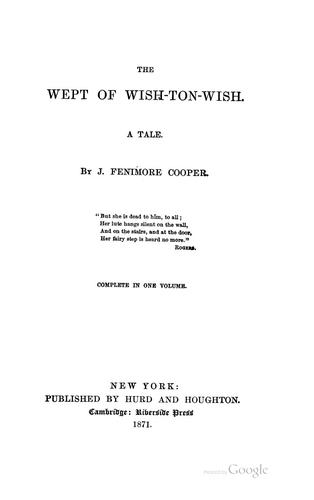
Historical fiction; King Philip's War, 1675-1676 -- Fiction; War stories
"This is warning we may not misconceive!" said Content, raising the
well-known emblem of ruthless hostility to the light, and exhibiting it
before the eyes of his less-instructed companion. "Boy, what have the
people of my race done, that thy warriors should seek their blood, to this
extremity?"
When the boy had discharged his duty, he moved aside, and appeared
unwilling to observe the effect which his message might produce on his
companions. But thus questioned, all gentle feelings were near being
forgotten, in the sudden force of passion. A hasty glance at Ruth quelled
the emotion, and he continued calm as ever, and silent.
"Boy," repeated Content, "I ask thee why thy people seek our blood?"
The passage of the electric spark is not more subtle, nor is it
scarcely more brilliant, than was the gleam that shot into the dark eye
of the Indian. The organ seemed to emit rays coruscant as the glance of
the serpent. His form appeared to swell with the inward strivings of
the spirit, and for a moment there was every appearance of a fierce and
uncontrollable burst of ferocious passion. The conquest of feeling was,
however, but momentary. He regained his self-command by a surprising
effort of the will, and advancing so near to him who had asked this
bold question, as to lay a finger on his breast, the young savage
haughtily said--
"See! this world is very wide. There is room on it for the panther and the
deer. Why have the Yengeese and the red-men met?"
"We waste the precious moments in probing the stern nature of a heathen,"
said the stranger. "The object of his people is certain, and, with the aid
of the Christian's staff, will we beat back their power. Prudence
requireth at our hands, that the lad be secured; after which, will we
repair to the stockades and prove ourselves men."
Against this proposal no reasonable objection could be raised. Content
was about to secure the person of his captive in a cellar, when a
suggestion of his wife caused him to change his purpose. Notwithstanding
the sudden and fierce mien of the youth, there had been such an
intelligence created between them by looks of kindness and interest, that
the mother was reluctant to abandon all hope of his aid.
"Miantonimoh!" she said, "though others distrust thy purpose, I will
have confidence. Come, then, with me; and while I give thee promise of
safety in thine own person, I ask at thy hands the office of a protector
for my babes."
The boy made no reply; but as he passively followed his conductress to the
chambers, Ruth fancied she read assurance of his faith, in the expression
of his eloquent eye. At the same moment, her husband and Submission left
the house, to take their stations at the palisadoes.
Chapter XIII.
"Thou art, my good youth, my page;
I'll be thy master: walk with me; speak freely."
Cymbeline.
Public-domain text, read in full here on John Shaqi.
Reviews
Reviews
No reviews yet
Be the first to share your thoughts on this work.
Elsewhere in the archive
Join the Discussion
Join the discussion
Sign in to leave a comment or review.
Sign InorCreate an account