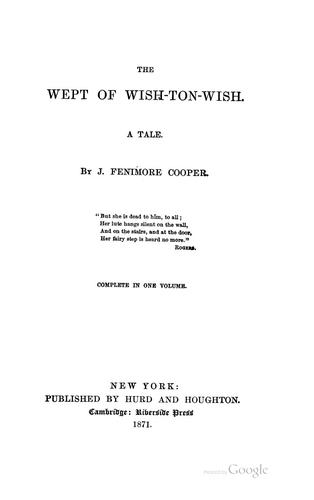
Historical fiction; King Philip's War, 1675-1676 -- Fiction; War stories
With this final admonition, the young men took their leaves. Still it was
evident, by their frowning brows and compressed lips, that some part of
its forgiving principle might be forgotten, should chance, in their
journey, bring them on the trail of any wandering inhabitant of the
forest. In a few minutes, they were seen passing, with swift steps, from
the fields into the depths of the forest, along that path which led to the
towns that lay lower on the Connecticut.
Another task still remained to be performed. In making the temporary
arrangements for the shelter of the family, attention had been first paid
to the block-house. The walls of the basement of this building were still
standing, and it was found easy, by means of half-burnt timbers, with an
occasional board that had escaped the conflagration, to cover it, in a
manner that offered a temporary protection against the weather. This
simple and hasty construction, with an extremely inartificial office
erected around the stack of a chimney, embraced nearly all that could be
done, until time and assistance should enable them to commence other
dwellings. In clearing the ruins of the little tower of its rubbish, the
remains of those who had perished in the fray were piously collected. The
body of the youth who had died in the earlier hours of the attack, was
found, but half-consumed, in the court, and the bones of two more, who
fell within the block, were collected from among the ruins. It had now
become a melancholy duty to consign them all to the earth, with decent
solemnity.
The time selected for this sad office was just as the western horizon
began to glow with that which one of our own poets has so beautifully
termed, "the pomp that brings and shuts the day." The sun was in the
tree-tops, and a softer or sweeter light could not have been chosen for
such a ceremony. Most of the fields still lay in the soft brightness of
the hour, though the forest was rapidly getting the more obscure look of
night. A broad and gloomy margin was spreading from the boundary of the
woods, and, here and there, a solitary tree cast its shadow on the meadows
without its limits, throwing a dark ragged line, in bold relief, on the
glow of the sun's rays. One, it was the dusky image of a high and waving
pine, that reared its dark green pyramid of never-fading foliage nearly a
hundred feet above the humbler growth of beeches, cast its shade to the
side of the eminence of the block. Here the pointed extremity of the
shadow was seen, stealing slowly towards the open grave,--an emblem of
that oblivion in which its humble tenants were so shortly to be wrapped.
Public-domain text, read in full here on John Shaqi.
Reviews
Reviews
No reviews yet
Be the first to share your thoughts on this work.
Elsewhere in the archive
Join the Discussion
Join the discussion
Sign in to leave a comment or review.
Sign InorCreate an account