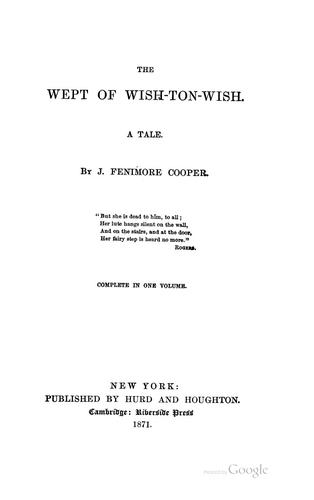
Historical fiction; King Philip's War, 1675-1676 -- Fiction; War stories
It is scarcely necessary to tell the American, that heavy wooden fences
subdivided the whole of this little landscape into inclosures of some
eight or ten acres in extent; that, here and there, cattle and flocks were
grazing without herdsmen or shepherds, and that, while the fields nearest
to the dwellings were beginning to assume the appearance of a careful and
improved husbandry, those more remote became gradually wilder and less
cultivated, until the half-reclaimed openings, with their blackened stubs
and barked trees, were blended with the gloom of the living forest. These
are, more or less, the accompaniments of every rural scene, in districts
of the country where time has not yet effected more than the first two
stages of improvement.
At the distance of a short half-mile from the fortified house, or
garrison, as by a singular corruption of terms the stockaded building was
called, stood a dwelling of pretensions altogether superior to any in the
hamlet. The buildings in question, though simple, were extensive; and
though scarcely other than such as might belong to an agriculturist in
easy circumstances, still they were remarkable, in that settlement, by the
comforts which time alone could accumulate, and some of which denoted an
advanced condition for a frontier family. In short, there was an air about
the establishment, as in the disposition of its out-buildings, in the
superior workmanship, in the materials, and in numberless other well-known
circumstances, which went to show that the whole of the edifices were
re-constructions. The fields near this habitation exhibited smoother
surfaces than those in the distance; the fences were lighter and less
rude; the stumps had absolutely disappeared, and the gardens and homestead
were well planted with flourishing fruit-trees. A conical eminence arose,
at a short distance, in the rear of the principal dwelling. It was covered
with that beautiful and peculiar ornament of an American farm, a regular,
thrifty, and luxuriant apple-orchard. Still, age had not given its full
beauty to the plantation, which might have had a growth of some eight or
ten years. A blackened tower of stone, which sustained the charred ruins
of a superstructure of wood, though of no great height in itself, rose
above the tallest of the trees, and stood a sufficient memorial of some
scene of violence, in the brief history of the valley. There was also a
small block-house near the habitation; but, by the air of neglect that
reigned around, it was quite apparent the little work had been of a
hurried construction, and of but temporary use. A few young plantations of
fruit-trees were also to be seen in different parts of the valley, which
was beginning to exhibit many other evidences of an improved agriculture.
Public-domain text, read in full here on John Shaqi.
Reviews
Reviews
No reviews yet
Be the first to share your thoughts on this work.
Elsewhere in the archive
Join the Discussion
Join the discussion
Sign in to leave a comment or review.
Sign InorCreate an account