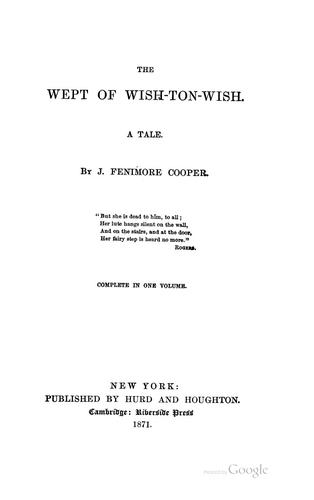
Historical fiction; King Philip's War, 1675-1676 -- Fiction; War stories
some bereaved mother of the tribe, by offering a substitute for the dead
in the person of a captive. There was relief, to picture the face of the
laughing cherub in the clouds, or to listen to its light footstep in the
empty halls of the dwelling; for in these illusive images of the brain,
suffering was confined to her own bosom. But when stern reality usurped
the place of fancy, and she saw her living daughter shivering in the
wintry blasts or sinking beneath the fierce heats of the climate,
cheerless in the desolation of female servitude, and suffering meekly the
lot of physical weakness beneath a savage master, she endured that anguish
which was gradually exhausting the springs of life.
Though the father was not altogether exempt from similar sorrow, it beset
him less ceaselessly. He knew how to struggle with the workings of his
mind, as best became a man. Though strongly impressed with the belief that
the captives had early been put beyond the reach of suffering, he had
neglected no duty, which tenderness to his sorrowing partner, parental
love, or Christian duty, could require at his hands.
The Indians had retired on the crust of the snow, and with the thaw every
foot-print, or sign, by which such wary foes might be traced, had
vanished. It remained matter of doubt to what tribe or even to what
nation, the marauders belonged. The peace of the colony had not yet been
openly broken, and the inroad had been rather a violent and fierce symptom
of the evils that were contemplated, than the actual commencement of the
ruthless hostilities which had since ravaged the frontier. But while
policy had kept the colonists quiet, private affection omitted no rational
means of effecting the restoration of the sufferers, in the event of their
having been spared.
Scouts had passed among the conspiring and but half-peaceable tribes,
nearest to the settlement, and rewards and menaces had both been liberally
used, in order to ascertain the character of the savages who had laid
waste the valley, as well as the more interesting fortunes of their
hapless victims. Every expedient to detect the truth had failed. The
Narragansetts affirmed that their constant enemies the Mohicans, acting
with their customary treachery, had plundered their English friends while
the Mohicans vehemently threw back the imputation on the Narragansetts. At
other times, some Indians affected to make dark allusions to the hostile
feelings of fierce warriors, who, under the name of the Five Nations, were
known to reside within the limits of the Dutch colony of New-Netherlands,
and to dwell upon the jealousy of the Pale-faces who spoke a language
different from that of the Yengeese. In short, inquiry had produced no
result; and Content, when he did permit his fancy to represent his
daughter as still living, was forced to admit to himself the probability
that she might be buried far in the ocean of wilderness which then covered
most of the surface of this continent.
Public-domain text, read in full here on John Shaqi.
Reviews
Reviews
No reviews yet
Be the first to share your thoughts on this work.
Elsewhere in the archive
Join the Discussion
Join the discussion
Sign in to leave a comment or review.
Sign InorCreate an account