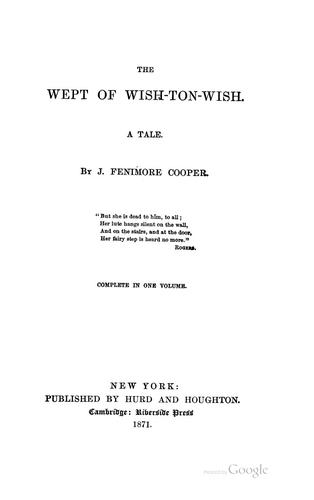
Historical fiction; King Philip's War, 1675-1676 -- Fiction; War stories
Notwithstanding her great self-command, and the object that was constantly
before the mind of Faith, she shuddered at the fierce pleasure with which
her brother pronounced the extent of the vengeance, that, in his imaginary
character, he believed he had taken on his enemies. Still cautious not to
destroy an illusion which might aid her, in the so-long-defeated and
so-anxiously-desired discovery, the woman repressed her horror, and
continued--
"True--yet some were spared--surely the warriors carried prisoners back to
their village. Thou didst not slay all?"
"All."
"Nay--thou speakest now of the miserables who were wrapt in the
blazing block; but--but some, without, might have fallen into thy
hands, ere the assailed sought shelter in the tower. Surely--surely
thou didst not kill all?"
The hard breathing of Ruth caught the ear of Whittal, and for a moment he
turned to regard her countenance in dull wonder. But again shaking his
head, he answered in a low, positive tone--"All;--ay, to the screeching
women and crying babes!"
"Surely there is a child--I would say there is a woman, in thy tribe, of
fairer skin and of form different from most of thy people. Was not such an
one led a captive from the burning of the Wish-Ton-Wish?"
"Dost think the deer will live with the wolf, or hast ever found the
cowardly pigeon in the nest of the hawk?"
"Nay, thou art of different color thyself, Whittal, and it well may be,
thou art not alone."
The youth regarded his sister a moment with marked displeasure, and then,
on turning to eat, he muttered--"There is as much fire in snow, as truth
in a lying Yengeese?"
"This examination must close," said Content, with a heavy sigh; "at
another hour, we may hope to push the matter to some more fortunate
result; but, yonder cometh one charged with especial service from the
towns below, as would seem by the fact that he disregardeth the holiness
of the day no less than by the earnest manner in which he is journeying."
As the individual named was visible to all who chose to look in the
direction of the hamlet, his sudden appearance caused a general
interruption to the interest which had been so strongly awakened on a
subject that was familiar to every resident in the valley.
The early hour, the gait at which the stranger urged his horse, the manner
in which he passed the open and inviting door of the Whip-Poor-Will,
proclaimed him a messenger, who probably bore some communication of
importance from the Government of the Colony to the younger Heathcote, who
filled the highest station of official authority in that distant
settlement. Observations to this purport had passed from mouth to mouth,
and curiosity was actively alive, by the time the horseman rode into the
court. There he dismounted, and, covered with the dust of the road, he
presented himself, with the air of one who had passed the night in the
saddle, before the man he sought.
Public-domain text, read in full here on John Shaqi.
Reviews
Reviews
No reviews yet
Be the first to share your thoughts on this work.
Elsewhere in the archive
Join the Discussion
Join the discussion
Sign in to leave a comment or review.
Sign InorCreate an account