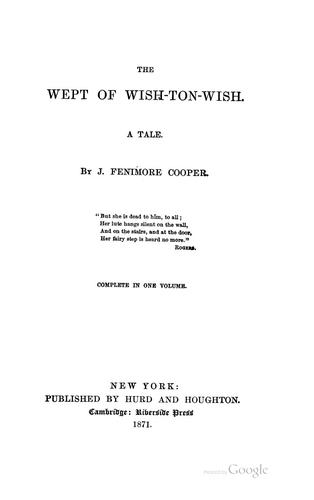
Historical fiction; King Philip's War, 1675-1676 -- Fiction; War stories
"Man of many winters," he commenced, in an English that was quite
intelligible, while it betrayed a difficulty of speech we shall not
attempt imitating, "why hath the Great Spirit made thy race like hungry
wolves?--why hath a Pale-face the stomach of a buzzard, the throat of a
hound, and the heart of a deer? Thou hast seen many meltings of the snow:
thou rememberest the young tree a sapling. Tell me; why is the mind of a
Yengeese so big, that it must hold all that lies between the rising and
the setting sun? Speak, for we would know the reason, why arms so long are
found on so little bodies?"
The events of that day had been of a nature to awaken all the latent
energies of the Puritan. He had lifted up his spirit, with the morning,
in the customary warmth with which he ever hailed the Sabbath; the
excitement of the assault had found him sustained above most earthly
calamities, and while it quickened feelings that can never become extinct
in one who has been familiar with martial usages, it left him, stern in
his manhood, and exalted in his sentiments of submission and endurance.
Under such influences, he answered with an austerity that equalled the
gravity of the Indian.
"The Lord hath delivered us into the bonds of the heathen," he said,
"and yet his name shall be blessed beneath my roof! Out of evil shall
come good; and from this triumph of the ignorant shall proceed an
everlasting victory!"
The chief gazed intently at the speaker, whose attenuated frame, venerable
face, and long locks, aided by the hectic of enthusiasm that played
beneath a glazed and deep-set eye, imparted a character that seemed to
rise superior to human weakness. Bending his head in superstitious
reverence, he turned gravely to those who, appearing to possess more of
the world in their natures, were more fitting subjects for the designs he
meditated.
"The mind of my father is strong, but his body is like a branch of the
scorched hemlock!" was the pithy declaration with which he prefaced his
next remark. "Why is this?" he continued, looking severely at the three
who had so lately been opposed to him in deadly contest. "Here are men
with skins like the blossom of the dog-wood, and yet their hands are so
dark that I cannot see them!"
"They have been blackened by toil, beneath a burning sun," returned
Content, who knew how to discourse in the figurative language of the
people in whose power he found himself. "We have labored, that our women
and children might eat."
"No--the blood of red men hath changed their color."
"We have taken up the hatchet, that the land which the Great Spirit hath
given might still be ours, and that our scalps might not be blown about in
the smoke of a wigwam. Would a Narragansett hide his arms, and tie up his
hands, with the war-whoop ringing in his ears?"
Public-domain text, read in full here on John Shaqi.
Reviews
Reviews
No reviews yet
Be the first to share your thoughts on this work.
Elsewhere in the archive
Join the Discussion
Join the discussion
Sign in to leave a comment or review.
Sign InorCreate an account