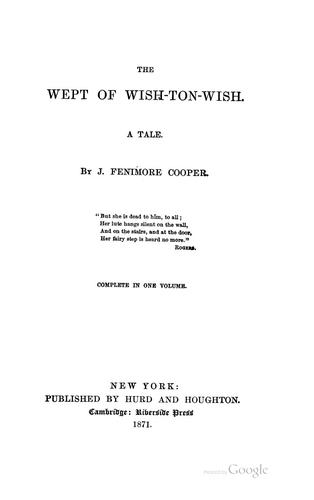
Historical fiction; King Philip's War, 1675-1676 -- Fiction; War stories
So long as the battle raged, their courage was equal to all its dangers;
but among people who made so great a merit of artifice, it is not at all
surprising that they seldom put more to the hazard than was justified by
the most severe discretion. When it was known, therefore, that the foe had
disappeared in the forest, the inhabitants of the village were more ready
to believe the movement was the result of their own manful resistance,
than to seek motives that might not prove so soothing to their
self-esteem. The retreat was thought to be quite in rule, and though
prudence forbade pursuit, able and well-limbed scouts were sent on their
trail, as well to prevent a renewal of the surprise, as to enable the
forces of the Colony to know the tribe of their enemies, and the direction
which they had taken.
Then came a scene of solemn ceremonies and of deep affliction. Though the
parties led by Dudley and the Lieutenant had been so fortunate as to
escape with a few immaterial wounds, the soldiers headed by Content, with
the exception of those already named, had fallen to a man. Death had
struck, at a blow, twenty of the most efficient individuals, out of that
isolated and simple community. Under circumstances in which victory was so
barren and so dearly bought, sorrow was a feeling far stronger than
rejoicing. Exultation took the aspect of humility, and while men were
conscious of their well-deserving, they were the more sensible of their
dependence on a power they could neither influence nor comprehend. The
characteristic opinions of the religionists became still more exalted, and
the close of the day was quite as remarkable for an exhibition of the
peculiarly exaggerated impressions of the Colonists, as its opening had
been frightful in violence and blood.
When one of the more active of the runners returned with the news that the
Indians had retired through the forest with a broad trail, a sure sign
that they meditated no further concealment near the valley, and that they
had already been traced many miles on their retreat, the villagers
returned to their usual habitations. The dead were then distributed among
those who claimed the nearest right to the performance of the last duties
of affection; and it might have been truly said, that mourning had taken
up its abode in nearly every dwelling. The ties of blood were so general
in a society thus limited, and, where they failed, the charities of life
were so intimate and so natural, that not an individual of them all
escaped, without feeling that the events of the day had robbed him, for
ever, of some one on whom he was partially dependent for comfort or
happiness.
Public-domain text, read in full here on John Shaqi.
Reviews
Reviews
No reviews yet
Be the first to share your thoughts on this work.
Elsewhere in the archive
Join the Discussion
Join the discussion
Sign in to leave a comment or review.
Sign InorCreate an account