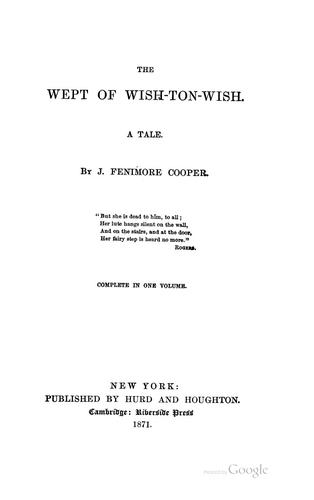
Historical fiction; King Philip's War, 1675-1676 -- Fiction; War stories
So useful a servant of the temple as Meek Wolfe did not forget the
practical application of his subject. It is true, that no visible emblem
of the cross was shown to excite his hearers, nor were they stimulated to
loosen blood-hounds on the trail of their enemies; but the former was kept
sufficiently before the mind's eye by constant allusions to its merits,
and the Indians were pointed at as the instruments by which the great
father of evil hoped to prevent 'the wilderness from blossoming like the
rose,' and 'yielding the sweet savors of godliness.' Philip and Conanchet
were openly denounced, by name; some dark insinuations being made, that
the person of the former was no more than the favorite tenement of Moloch;
while the hearer was left to devise a suitable spirit for the government
of the physical powers of the other, from among any of the more evil
agencies that were named in the Bible. Any doubts of the lawfulness of the
contest, that might assail tender consciences, were brushed away by a bold
and decided hand. There was no attempt at justification, however; for all
difficulties of this nature were resolved by the imperative obligations of
duty. A few ingenious allusions to the manner in which the Israelites
dispossessed the occupants of Judea, were of great service in this
particular part of the subject, since it was not difficult to convince
men, who so strongly felt the impulses of religious excitement, that they
were stimulated rightfully. Fortified by this advantage, Mr. Wolfe
manifested no desire to avoid the main question. He affirmed that if the
empire of the true faith could be established by no other means, a
circumstance which he assumed it was sufficiently apparent to all
understandings could not be done, he pronounced it the duty of young and
old, the weak and the strong, to unite in assisting to visit the former
possessors of the country with what he termed the wrath of an offended
Deity. He spoke of the fearful slaughter of the preceding winter, in which
neither years nor sex had been spared, as a triumph of the righteous
cause, and as an encouragement to persevere. Then, by a transition that
was not extraordinary in an age so remarkable for religious subtleties,
Meek returned to the more mild and obvious truths which pervade the
doctrines of him whose church he professed to uphold. His hearers were
admonished to observe lives of humility and charity, and were piously
dismissed, with his benediction, to their several homes.
Public-domain text, read in full here on John Shaqi.
Reviews
Reviews
No reviews yet
Be the first to share your thoughts on this work.
Elsewhere in the archive
Join the Discussion
Join the discussion
Sign in to leave a comment or review.
Sign InorCreate an account