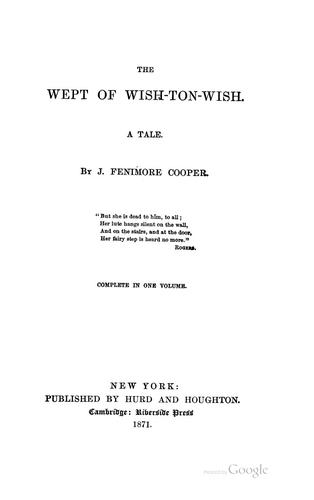
Historical fiction; King Philip's War, 1675-1676 -- Fiction; War stories
Precisely at that point where a sweep of the mountain permitted the best
view of the valley, did the rocks assume the wildest, the most confused,
and consequently the most favorable appearance for the construction of any
residence which it was desirable should escape the curious eyes of the
settlers, at the same time that it possessed the advantage of overlooking
their proceedings. A hermit would have chosen the place as a spot suited
to distant and calm observation of the world, while it was every way
adapted to solitary reflection and ascetic devotion. All who have
journeyed through the narrow and water-worn vineyards and meadows which
are washed by the Rhone, ere that river pours its tribute into the Lake of
Leman, have seen some such site, occupied by one who has devoted his life
to seclusion and the altar, overhanging the village of St. Maurice, in the
Canton of le Valais. But there is an air of obtrusiveness in the Swiss
hermits age that did not belong to the place of which we write, since the
one is perched upon its high and narrow ledge, as if to show the world in
what dangerous and circumscribed limits God may be worshipped; while the
other sought exemption from absolute solitude, while it courted secrecy
with the most jealous caution. A small hut had been erected against the
side of the rock, in a manner that presented an oblique angle. Care had
been taken to surround it with such natural objects as left little reason
to apprehend that its real character could be known by any who did not
absolutely mount to the difficult shelf on which it stood. Light entered
into this primitive and humble abode by a window that looked into the
ravine, and a low door opened on the side next the valley. The
construction was partly of stone and partly of logs, with a roof of bark
and a chimney of mud and sticks.
One who, by his severe and gloomy brow, was a fit possessor of so secluded
a tenement, was, at the hour named, seated on a stone at the most salient
angle of the mountain, and at the place where the eye commanded the widest
and least-obstructed view of the abodes of man in the distance. Stones had
been rolled together in a manner to form a little breastwork in his front,
so that, had there been any wandering gaze sweeping over the face of the
mountain, it was far from probable that it would have detected the
presence of a man whose whole form, with the exception of the superior
parts, was so effectually concealed.
Public-domain text, read in full here on John Shaqi.
Reviews
Reviews
No reviews yet
Be the first to share your thoughts on this work.
Elsewhere in the archive
Join the Discussion
Join the discussion
Sign in to leave a comment or review.
Sign InorCreate an account