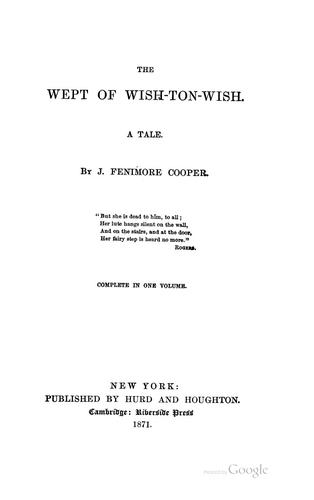
Historical fiction; King Philip's War, 1675-1676 -- Fiction; War stories
She spoke to an ear that was deaf to language like this. Narra-mattah
evidently understood her words, while their meaning was wrapped in an
obscurity that she neither wished to nor was capable of comprehending.
Keeping a gaze, in which pleasure and wonder were powerfully blended, on
that soft look of affection which beamed from her mother's eye, she felt
hurriedly among the folds of her dress, and drawing a belt that was gaily
ornamented after the most ingenious fashion of her adopted people, she
approached her half-pleased, half-distressed parent, and, with hands that
trembled equally with timidity and pleasure, she arranged it around her
person in a manner to show its richness to the best advantage. Pleased
with her performance, the artless being eagerly sought approbation in eyes
that bespoke little else than regret. Alarmed at an expression she could
not translate, the gaze of Narra-mattah wandered, as if it sought support
against some sensation to which she was a stranger. Whittal Ring had
stolen into the room, and missing the customary features of her own
cherished home, the looks of the startled creature rested on the
countenance of the witless wanderer. She pointed eagerly at the work of
her hands, appealing by an eloquent and artless gesture to the taste of
one who should know whether she had done well.
"Bravely!" returned Whittal, approaching nearer to the subject of his
admiration--"'tis a brave belt, and none but the wife of a Sachem could
make so rare a gift!"
The girl folded her arms meekly on her bosom, and again appeared satisfied
with herself and with the world.
"Here is the hand of him visible who dealeth in all wickedness," said the
Puritan. "To corrupt the heart with vanities, and to mislead the
affections by luring them to the things of life, is the guile in which he
delighteth. A fallen nature lendeth but too ready aid. We must deal with
the child in fervor and watchfulness, or better that her bones were lying
by the side of those little ones of thy flock, who are already inheritors
of the promise."
Respect kept Ruth silent; but, while she sorrowed over the ignorance of
her child, natural affection was strong at her heart. With the tact of a
woman and the tenderness of a mother, she both saw and felt that severity
was not the means to effect the improvement they desired. Taking a seat
herself, she drew her child to her person, and, first imploring silence by
a glance at those around her, she proceeded, in a manner that was dictated
by the mysterious influence of nature, to fathom the depth of her
daughter's mind.
"Come nearer, Narra-mattah;" she said, using the name to which the other
would alone answer. 'Thou art still in thy youth, my child; but it hath
pleased him whose will is law, to have made thee the witness of many
changes in this varying life. Tell me if thou recallest the days of
infancy, and if thy thoughts ever returned to thy father's house, during
those weary years thou wast kept from our view?'
Public-domain text, read in full here on John Shaqi.
Reviews
Reviews
No reviews yet
Be the first to share your thoughts on this work.
Elsewhere in the archive
Join the Discussion
Join the discussion
Sign in to leave a comment or review.
Sign InorCreate an account