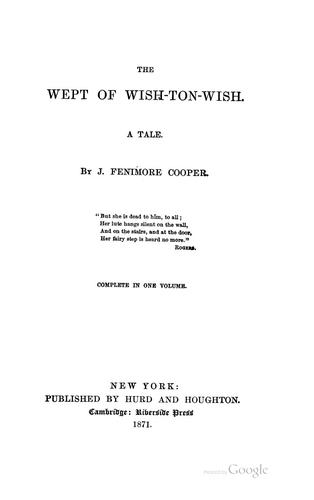
Historical fiction; King Philip's War, 1675-1676 -- Fiction; War stories
Ruth could not resist the appeal of her beloved. Bending her head low, so
as entirely to conceal her own flushed face, she imprinted a kiss on the
forehead of the Indian boy. But the jealous eye of the young mother was
not to be deceived. Narra-mattah detected the difference between the cold
salute and those fervent embraces she had herself received, and
disappointment produced a chill about her own heart. Replacing the folds
of the cloth with quiet dignity, she arose from her knees, and withdrew in
sadness to a distant corner of the room. There she took a seat, and with a
glance that might almost be termed reproachful, she commenced a low Indian
song to her infant.
"The wisdom of Providence is in this, as in all its dispensations;"
whispered Content over the shoulder of his nearly insensible partner.
"Had we received her as she was lost, the favor might have exceeded
our deservings. Our daughter is grieved that thou turnest a cold eye
on her babe."
The appeal was sufficient for one whose affections had been wounded rather
than chilled. It recalled Ruth to recollection, and it served at once to
dissipate the shades of regret that had been unconsciously permitted to
gather around her brow. The displeasure, or it would be more true to term
it sorrow, of the young mother was easily appeased. A smile on her infant
brought the blood back to her heart in a swift and tumultuous current; and
Ruth, herself, soon forgot that she had any reason for regret, in the
innocent delight with which her own daughter now hastened to display the
physical excellence of the boy. From this scene of natural feeling,
Content was too quickly summoned by the intelligence that some one without
awaited his presence, on business of the last importance to the welfare of
the settlement.
Chapter XXVIII.
"It will have blood; they say, blood
Will have blood!"
Macbeth.
The visiters were Dr. Ergot, the Reverend Meek Wolfe, Ensign Dudley, and
Reuben Ring. Content found these four individuals seated in an outer room,
in a grave and restrained manner, that would have done no discredit to the
self-command of an Indian council. He was saluted with those staid and
composed greetings which are still much used in the intercourse of the
people of the Eastern States of this Republic, and which have obtained for
them a reputation, where they are little known, of a want of the more
active charities of our nature. But that was peculiarly the age of
sublimated doctrines, of self-mortification, and of severe moral
government, and most men believed it a merit to exhibit, on all
occasions, the dominion of the mind over the mere animal impulses. The
usage, which took its rise in exalted ideas of spiritual perfection, has
since grown into a habit, which, though weakened by the influence of the
age, still exists to a degree that often leads to an erroneous estimate of
character.
Public-domain text, read in full here on John Shaqi.
Reviews
Reviews
No reviews yet
Be the first to share your thoughts on this work.
Elsewhere in the archive
Join the Discussion
Join the discussion
Sign in to leave a comment or review.
Sign InorCreate an account