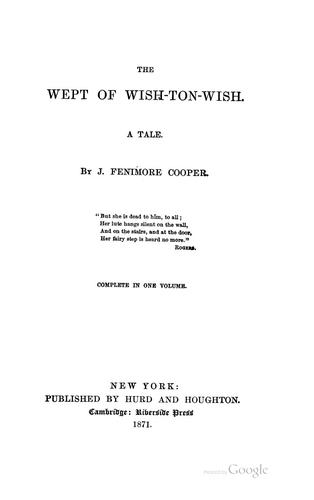
Historical fiction; King Philip's War, 1675-1676 -- Fiction; War stories
He paused, for at that moment a door opened, and a party entered bearing a
burthen, which they deposited, with decent and grave respect, on the
floor, in the very centre of the room. The unceremonious manner of the
entrance, the assured and the common gravity of their air, proclaimed that
the villagers felt their errand to be a sufficient apology for this
intrusion. Had not the business of the past day naturally led to such a
belief, the manner and aspects of those who had borne the burthen would
have announced it to be a human body.
"I had believed that none fell in this day's strife, but those who met
their end near my own door," said Content, after a long, respectful, and
sorrowing pause. "Remove the face-cloth, that we may know on whom the blow
hath fallen."
One of the young men obeyed. It was not easy to recognise, through the
mutilations of savage barbarity, the features of the sufferer. But a
second and steadier look showed the gory and still agonized countenance of
the individual who had, that morning, left the Wish-Ton-Wish on the
message of the colonial authorities. Even men as practised as those
present, in the horrible inventions of Indian cruelty, turned sickening
away from a spectacle that war calculated to chill the blood of all who
had not become callous to human affliction. Content made a sign to cover
the miserable remnants of mortality, and hid his face, with a shudder.
It is not necessary to dwell on the scene that followed. Meek Wolfe
availed himself of this unexpected event, to press his plan on the
attention of the commanding officer of the settlement, who was certainly
far better disposed to listen to his proposals, than before this palpable
evidence of the ruthless character of their enemies was presented to his
view. Still Content listened with reluctance, nor was it without the
intention of exercising an ulterior discretion in the case, that he
finally consented to give orders for the departure of a body of men, with
the approach of the morning light. As much of the discourse was managed
with those half-intelligible allusions that distinguished men of their
habits, it is probable that every individual present had his own
particular views of the subject: though it is certain, one and all
faithfully believed that he was solely influenced by a justifiable regard
to his temporal interest, which was in some degree rendered still more
praiseworthy by a reference to the service of his Divine Master.
As the party returned, Dudley lingered a moment, alone, with his former
master. The face of the honest-meaning Ensign was charged with more than
its usual significance; and he even paused a little, after all were beyond
hearing, ere he could muster resolution to propose the subject that was so
evidently uppermost in his mind.
Public-domain text, read in full here on John Shaqi.
Reviews
Reviews
No reviews yet
Be the first to share your thoughts on this work.
Elsewhere in the archive
Join the Discussion
Join the discussion
Sign in to leave a comment or review.
Sign InorCreate an account