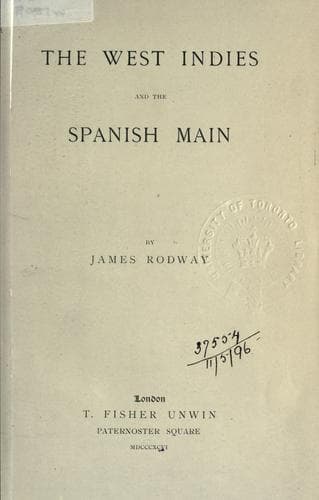
Slavery -- West Indies; Spanish Main; West Indies -- History
Here he hoped to gain recruits from among the Spanish people of the
island, to whom he issued an address. The glorious opportunity, he said,
presented itself of relieving from oppression and arbitrary government a
people who were worthy of a better fate, but who were shackled by a
despotism too cruel for human nature longer to endure. Groaning under
their afflictions they hailed with extended arms the noble cause of
freedom and independence, and called upon them to share the God-like
action of relieving them.
This stirring address made little impression, and consequently few
followers were enrolled. However, he got eight armed vessels and two
traders, and sailed from Trinidad on the 25th of July, 1806, for Coro on
the Main. The fort and city were taken, but the people, instead of
joyfully welcoming their deliverers, ran away and could not be induced
to return. Miranda, finding the place untenable, went over to Aruba, of
which he took possession as a basis for further operations. But the
British authorities looked upon his scheme as impracticable, especially
as it tended to injure their trade, and in November Miranda was
compelled to disband his little company of less than three hundred at
Trinidad.
The time for a revolution had not yet arrived, but it was fast
approaching. It could not be expected that Great Britain would assist
filibustering against her ally, which Spain now became, and without some
outside assistance Miranda found it impossible to do anything. However,
the people themselves were at last aroused, and on the 19th of April,
1810, the city of Caracas deposed the captain-general and appointed a
Junta to rule in the name of the king. This body invited the other
provinces to join and form a league for mutual protection against the
French, who now had virtual possession of the mother country. Other
provinces took the Government side and prepared to suppress the revolt,
which led Caracas to ask the assistance of Great Britain and the United
States.
Among the Venezuelans was Simon Bolivar, who afterwards became the most
important personage in the struggle for independence. Like Miranda, he
was a native of South America, and like him had imbibed revolutionary
ideas in Paris. He was a planter, and had taken no part in the overthrow
of the captain-general, but from his principles being well known, he was
appointed with others to proceed to London in the interests of the
Junta. On their arrival they were answered cautiously, the authorities
not wishing to commit themselves under the circumstances. Here Bolivar
met Miranda, and took the oath of the "Gran Reunion," promising to work
for the independence of South America, notwithstanding his nominal
position as an advocate of the king of Spain against Napoleon.
Public-domain text, read in full here on John Shaqi.
Reviews
Reviews
No reviews yet
Be the first to share your thoughts on this work.
Elsewhere in the archive
Join the Discussion
Join the discussion
Sign in to leave a comment or review.
Sign InorCreate an account