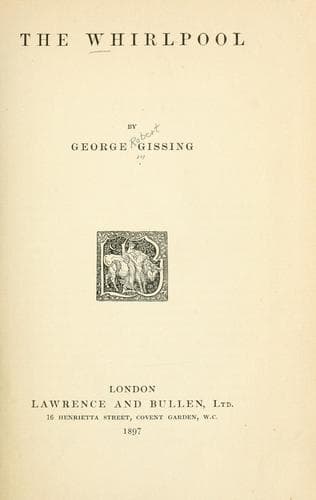
England -- Social life and customs -- 19th century -- Fiction; English fiction -- 19th century
When Mrs. Frothingham went upstairs with the letter for Alma, he broke
open another envelope. It was from Mary Abbott, who wrote to him twice
a year, when she acknowledged the receipt of his cheque. She sent the
usual careful report concerning Wager's children--the girl now seven
years old, and the boy nine. Albert Wager, she thought, was getting too
old for her; he ought to go to a boys' school. Neither he nor his
sister had as yet repaid the care given to them; never were children
more difficult to manage. Harvey read this between the lines; for Mary
Abbott never complained of the task she had undertaken. He rose and
left the room with a face of anxious thoughtfulness.
The day was wont to pass in a pretty regular routine. From half-past
nine to half-past one Harvey sat alone in his study, not always
energetically studious, but on the whole making progress in his chosen
field of knowledge. He bought books freely, and still used the London
Library. Of late he had been occupying himself with the authorities on
education; working, often impatiently, through many a long-winded
volume. He would have liked to talk on this subject with Mary Abbott,
but had not yet found courage to speak of her paying them a visit. The
situation, difficult because of Alma's parentage, was made more awkward
by his reticence with Alma regarding the payment he made for those
luckless children. The longer he kept silence, the less easily could he
acquaint his wife with this matter--in itself so perfectly harmless.
This morning he felt indisposed for study, and cared just as little to
go out, notwithstanding the magnificent sky. From his windows he looked
upon the larch-clad slopes of Cam Bodvean; their beauty only reminded
him of grander and lovelier scenes in far-off countries. From time to
time the wanderer thus awoke in him, and threw scorn upon the
pedantries of a book-lined room. He had, moreover, his hours of regret
for vanished conviviality; he wished to step out into a London street,
collect his boon-companions, and hold revel in the bygone way. These,
however, were still but fugitive moods. All in all, he regretted
nothing. Destiny seemed to have marked him for a bookish man; he grew
more methodical, more persistent, in his historical reading; this,
doubtless, was the appointed course for his latter years. It led to
nothing definite. His life would be fruitless----
Public-domain text, read in full here on John Shaqi.
Reviews
Reviews
No reviews yet
Be the first to share your thoughts on this work.
Elsewhere in the archive
Join the Discussion
Join the discussion
Sign in to leave a comment or review.
Sign InorCreate an account