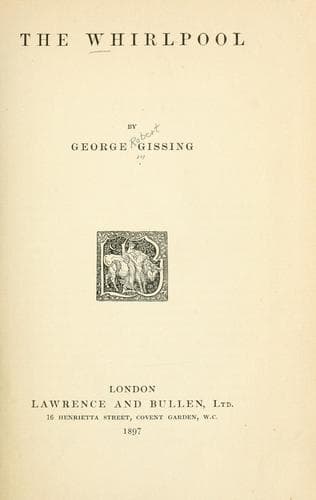
England -- Social life and customs -- 19th century -- Fiction; English fiction -- 19th century
Harvey mused. Wishing to feel himself in complete sympathy with his
friend, he knew that something of the old criticism still tempered his
liking. Mary Abbott had fine qualities, but lacked the simplicity, the
directness, which would have made her courage wholly admirable. He
suspected that she continually mourned over what seemed to her a waste
of life. Proud of her 'culture', remembering her distinction as a
teacher of grown-up girls, she had undertaken as a penitence the care
of little children, and persevered in it with obstinacy rather than
with inspired purpose. Mary Abbott, doubtless, had always regarded life
as a conflict; she had always fought for her own hand. When such a
nature falls into genuine remorse, asceticism will inevitably follow;
with it comes the danger of more or less conscious embitterment. Harvey
had a conviction of his friend's sincerity, and believed her in every
way a better woman than in the days before her great sorrow; but he
could not yet assure himself that she had found her true vocation.
They spoke of the people who were so anxious to be relieved of their
children.
'One lady wrote to me that she would pay almost anything if I would
take her little boy and keep him all the year round; she has only a
small house, and the child utterly upsets her life. Of course, I
understand her; I should have sympathised with her once.'
'It's intelligible enough,' replied Harvey, with a laugh. 'Presently
there will be huge establishments for the young children of
middle-class people. Naturally, children are a nuisance; especially so
if you live in a whirlpool.'
'Yes, I know it too well, the whirlpool way of life,' said Mrs. Abbott,
her eyes on the far mountains. 'I know how easily one is drawn into it.
It isn't only idle people.'
'Of course not. There's the whirlpool of the furiously busy. Round and
round they go; brains humming till they melt or explode. Of course,
they can't bother with children.'
'One loses all sense of responsibility.'
'Rather, they have never had it, and it has no chance of developing.
You know, it isn't a matter of course for people to see that they are
under an enormous obligation to the children they bring into the world;
except in a parent here and there, that comes only with very favourable
circumstances. When there's no leisure, no meditation, no peace and
quietness,--when, instead of conversing, people just nod or shout to
each other as they spin round and round the gulf,--men and women
practically return to the state of savages in all that concerns their
offspring. The brats have come into existence, and must make the best
of it. Servants, governesses, schoolmasters--anybody but the
parents--may give thought to children. Well, it's a matter for the
individual. I shouldn't feel comfortable myself.'
'It's a matter for the world, too,' said Mary.
Public-domain text, read in full here on John Shaqi.
Reviews
Reviews
No reviews yet
Be the first to share your thoughts on this work.
Elsewhere in the archive
Join the Discussion
Join the discussion
Sign in to leave a comment or review.
Sign InorCreate an account