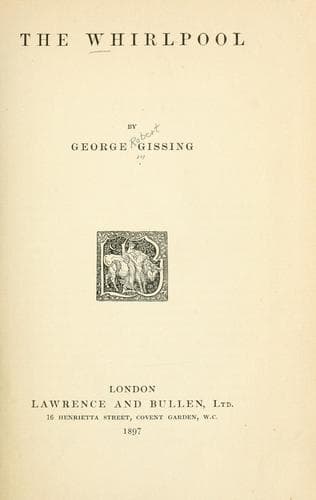
England -- Social life and customs -- 19th century -- Fiction; English fiction -- 19th century
A visit was due from Mrs. Frothingham, who had not been seen at Pinner
for more than six months. She would have come at New Year, but an
attack of influenza upset her plans. Now she wrote to announce her
arrival on Saturday.
'I wish it had been Monday,' said Alma; 'I have to go to the Crystal
Palace.'
'Is it imperative?' asked her husband.
'Yes; there's something new of Sterndale Bennett's, and I've asked
Dora.'
It seemed to Harvey that this arrangement might have been put aside
without great inconvenience, but, as usual, he made no comment. As he
would be in town on Saturday, he promised to meet their visitor at
Waterloo. Alma, he thought, had never shown much gratitude for her
step-mother's constant kindness; during the past half-year she had now
and then complained of the trouble of answering Mrs. Frothingham's
letters, and the news of illness at Basingstoke drew from her only a
few words of conventional sympathy. To Hughie, who frequently received
presents from 'Grandmamma', she rarely spoke of the affectionate giver.
A remark of hers recently on some piece of news from Mrs. Frothingham
bore an obvious suggestion.
'I wonder,' she said, 'if a single person has been really benefited by
all the money Mamma has given away? Isn't it likely she has done much
more harm than good?'
There was truth in his surmise that Alma sometimes thought with
jealousy of Mrs. Frothingham's having had control of a fortune, whilst
she, the only child of him who made the money, possessed nothing of her
own. The same trend of feeling appeared in a word or two of Alma's,
when a daily paper, in speaking of a paltry dividend offered at last to
the creditors in one branch of Bennet Frothingham's speculations, used
a particularly bitter phrase.
'I should have felt that once; now----'
In these days Alma suffered from a revival of the indignation which had
so perturbed her in the time just before her marriage. If now she had
possessed even a little money, it would have made her independent in a
sense far more tangible than that of the friendly understanding with
her husband. She strongly disliked the thought of making Harvey
responsible for the expenses of her 'recital'. Had it been possible to
procure a small sum by any honest means, she would eagerly have turned
to it; but no method seemed discoverable. On her journey homeward after
the interview with Felix Dymes, her mind was full of the money
question. What did Dymes mean by bidding her take no thought for
expenses? Could it have occurred to his outrageous vanity that she
might be persuaded to become his debtor, with implied obligation of
gratitude?
Public-domain text, read in full here on John Shaqi.
Reviews
Reviews
No reviews yet
Be the first to share your thoughts on this work.
Elsewhere in the archive
Join the Discussion
Join the discussion
Sign in to leave a comment or review.
Sign InorCreate an account