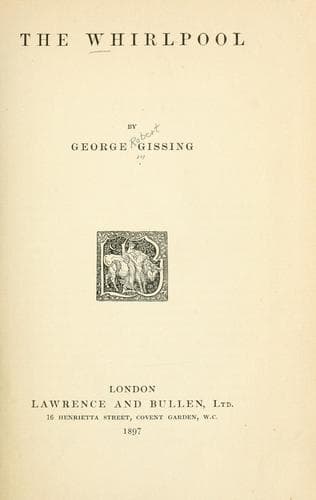
England -- Social life and customs -- 19th century -- Fiction; English fiction -- 19th century
It was not the first time that Alma affected to be absorbed in music
when not consciously hearing it at all. Today the circumstances made
such distraction pardonable; but often enough she had sat thus, with
countenance composed or ecstatic, only seeming to listen, even when a
master played. For Alma had no profound love of the art. Nothing more
natural than her laying it completely aside when, at home in Wales, she
missed her sufficient audience. To her, music was not an end in itself.
Like numberless girls, she had, to begin with, a certain mechanical
aptitude, which encouraged her through the earlier stages, until vanity
stepped in and urged her to considerable attainments. Her father's
genuine delight in music of the higher kind served as an encouragement
whenever her own energies began to fail; and when at length, with
advancing social prospects, the thought took hold of her that, by means
of her violin, she might maintain a place of distinction above ordinary
handsome girls and heiresses, it sufficed to overcome her indolence and
lack of the true temper. She founded her Quartet Society, and queened
it over amateurs, some of whom were much better endowed than herself.
Having set her pride on winning praise as a musician, of course she
took pains, even working very hard from time to time. She had
first-rate teachers, and was clever enough to profit by their lessons.
With it all, she cared as little for music as ever; to some extent it
had lost even that power over her sensibilities which is felt by the
average hearer. Alma had an emotional nature, but her emotions
responded to almost any kind of excitement sooner than to the musical.
So much had she pretended and posed, so much had she struggled with
mere manual difficulties, so much lofty cant and sounding hollowness
had she talked, that the name of her art was grown a weariness, a
disgust. Conscious of this, she was irritated whenever Harvey begged
her to play simple things; for indeed, if she must hear music at all,
it was just those simple melodies she would herself have preferred. And
among the self-styled musical people with whom she associated, were
few, if any, in whom conceit did not sound the leading motive. She knew
but one true musician, Herr Wilenski. That the virtuoso took no trouble
to bring her in touch with his own chosen circle, was a significant
fact which quite escaped Alma's notice.
Between the pieces Redgrave chatted in a vein of seductive familiarity,
saying nothing that Dora Leach might not have heard, but frequently
softening his voice, as though to convey intimate meanings. His manner
had the charm of variety; he was never on two occasions alike; today he
seemed to relax in a luxurious mood, due in part to the influence of
sound, and in part, as his eyes declared, to the sensuous pleasure of
sitting by Alma's side.
'What an excellent fellow Carnaby is!' he remarked unexpectedly. 'I
have been seeing a good deal of him lately--as you know, I think?'
Public-domain text, read in full here on John Shaqi.
Reviews
Reviews
No reviews yet
Be the first to share your thoughts on this work.
Elsewhere in the archive
Join the Discussion
Join the discussion
Sign in to leave a comment or review.
Sign InorCreate an account