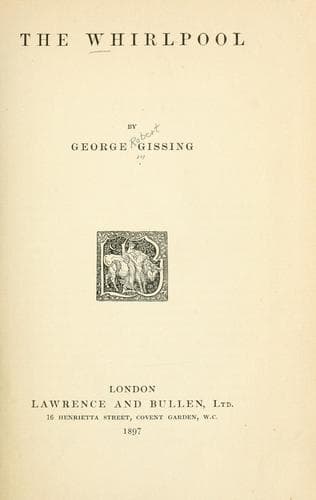
England -- Social life and customs -- 19th century -- Fiction; English fiction -- 19th century
From the entrance to Mrs. Fenimore's round to the by-road which was the
direct approach to Redgrave's bungalow would be a walk of some ten
minutes. Hugh had his reasons for not taking this direction. Having
dismissed his cab, he entered by the lodge-gate, and walked up the
drive, moving quickly, and with a lighter step than was natural to him.
When he came within view of the house, he turned aside, and made his
way over the grass, in the deep shadow of leafy lime-trees, until the
illumined windows were again hidden from him. He had seen no one, and
heard no sound. A path which skirted the gardens would bring him in a
few minutes to Redgrave's abode; this he found and followed.
The bungalow was built in a corner of the park where previously had
stood a gardener's cottage; round about it grew a few old trees, and on
two sides spread a shrubbery, sheltering the newly-made lawn and
flower-beds. Here it was very dark; Hugh advanced cautiously, stopping
now and then to listen. He reached a point where the front of the house
became visible. A light shone at the door, but there was no movement,
and Hugh could hear only his own hard breathing.
He kept behind the laurels, and made a half-circuit of the house. On
passing to the farther side, he would come within view of those windows
which opened so conveniently, as Mrs. Maskell had said--the windows of
Redgrave's sitting-room, drawing-room, study, or whatever he called it.
To this end it was necessary to quit the cover of the shrubs and cross
a lawn. As he stepped on to the mown grass, his ear caught a sound, the
sound of talking in a subdued tone; it came, he thought, from that side
of the building which he could not yet see. A few quick silent steps,
and this conjecture became a certainty: someone was talking within a
few yards of him, just round the obstructing corner, and he felt sure
the voice was Redgrave's. It paused; another voice made reply, but in
so low a murmur that its accents were not to be recognised. That it was
the voice of a woman the listener had no doubt. Spurred by a choking
anguish, he moved forward. He saw two figures standing in a dim light
from the window-door--a man and a woman; the man bareheaded, his
companion in outdoor clothing. At the same moment he himself was
perceived. He heard a hurried 'Go in!' and at once the woman
disappeared.
Face to face with Redgrave, he looked at the window; but the curtain
which dulled the light from within concealed everything.
'Who was that?'
'Why--Carnaby? What the deuce----?'
'Who was _that_?'
'Who?--what do you mean?'
Carnaby took a step; Redgrave laid an arresting hand upon him. There
needed but this touch. In frenzied wrath, yet with the precision of
trained muscle, Hugh struck out; and Redgrave went down before
him--thudding upon the door of the veranda like one who falls dead.
CHAPTER 13
He forced the window; he rushed into the room, and there before him,
pallid, trembling, agonising, stood Alma Rolfe.
'You?'
Public-domain text, read in full here on John Shaqi.
Reviews
Reviews
No reviews yet
Be the first to share your thoughts on this work.
Elsewhere in the archive
Join the Discussion
Join the discussion
Sign in to leave a comment or review.
Sign InorCreate an account