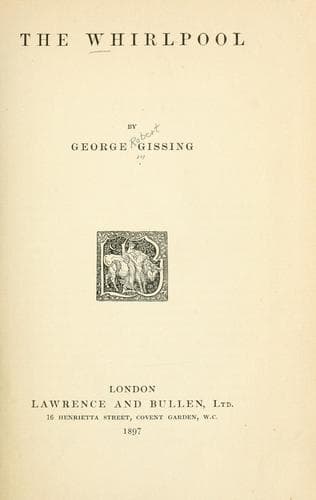
England -- Social life and customs -- 19th century -- Fiction; English fiction -- 19th century
As usual when at Greystone, Harvey took his first walk to the spots
associated with his childhood. He walked alone, for Morton had gone to
business until midday. On the outskirts of the town, in no very
pleasant situation, stood the house where he was born; new buildings
had risen round about it, and the present tenants seemed to be
undesirable people, who neglected the garden and were careless about
their window curtains. Here he had lived until he was ten years
old--till the death of his father. His mother died long before that; he
just, and only just, remembered her. He knew from others that she was a
gentle, thoughtful woman, always in poor health; the birth of her
second child, a girl, led to a lingering illness, and soon came the
end. To her place as mistress of the house succeeded Harvey's aunt, his
father's sister. No one could have been kinder to the children, but
Harvey, for some reason yet obscure to him, always disliked her. Whom,
indeed, did he not dislike, of those set over him? He recalled his
perpetual rebellion against her authority from the first day to the
last. What an unruly cub! And his father's anger when he chanced to
overhear some boyish insolence--alas! alas!
For he saw so little of his father. Mr. Rolfe's work as a railway
engineer kept him chiefly abroad; he was sometimes absent for twelve
months at a time. Only in the last half-year of his life did he remain
constantly at home, and that because he was dying. Having contracted a
fever in Spain, he came back to recruit; but his constitution had
suffered from many hardships, and now gave way. To the last day (though
he was ten years old) Harvey never dreamt of what was about to happen.
Self-absorbed in a degree unusual even with boys, he feared his father,
but had not learnt to love him. And now, looking back, he saw only too
well why the anxious parent treated him with severity more often than
with gentleness and good humour. A boy such as he must have given sore
trouble to a father on his death-bed.
When it was too late, too late by many a year, he mourned the loss
which had only startled him, which had seemed hardly a loss at all,
rather an emancipation. As a man of thirty, he knew his father much
better than when living with him day after day. Faults he could
perceive, some of them inherited in his own character; but there
remained the memory of a man whom he could admire and love--whom he did
admire and love more sincerely and profoundly the older he grew. And he
held it the supreme misfortune of his life that, in those early years
which count so much towards the future, he had been so rarely under his
father's influence.
Inevitable, it seemed. Yet only so, perhaps, because even a good and
conscientious man may fail to understand the obligation under which he
lies towards his offspring.
Public-domain text, read in full here on John Shaqi.
Reviews
Reviews
No reviews yet
Be the first to share your thoughts on this work.
Elsewhere in the archive
Join the Discussion
Join the discussion
Sign in to leave a comment or review.
Sign InorCreate an account