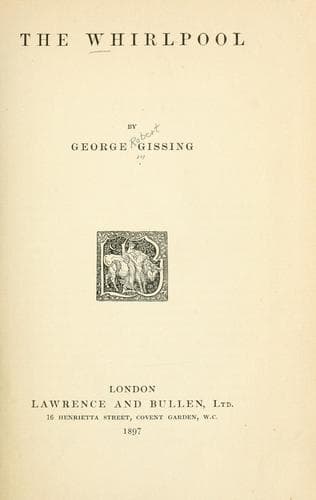
England -- Social life and customs -- 19th century -- Fiction; English fiction -- 19th century
The possession of money had done him good. It clarified his passions,
or tended that way. A self-respect, which differed appreciably from
what he had formerly understood by that term, began to guard him
against grossness; together with it there developed in him a new social
pride which made him desire the acquaintance of well-bred people.
Though he had no longer any communication with the good old Doctor, Amy
frequently wrote to him, and in one of her letters she begged him to
call on a family in London, one of whose younger members lived at
Greystone and was Amy's friend. After much delay, he overcame his
bashfulness, and called upon the worthy people--tailored as became a
gentleman at large. The acquaintance led to others; in a short time he
was on pleasant terms with several well-to-do families. He might have
suspected--but at the time, of course, did not--that Dr Harvey's kindly
influence had something to do with his reception in these houses.
Self-centred, but painfully self-distrustful, he struggled to overcome
his natural defects of manner. Possibly with some success; for did not
Lily Burton, who at first so piqued him by her critical smile, come to
show him tolerance, friendliness, gracious interest?
Lily Burton!--how emptily, how foolishly the name tinkled out of that
empty and foolish past! Yet what a power it had over him when he was
three and twenty! Of all the savage epithets which he afterwards
attached to its owner, probably she merited a few. She was a flirt, at
all events. She drew him on, played upon his emotions, found him, no
doubt, excellent fun; and at last, when he was imbecile enough to
declare himself, to talk of marriage, Lily, raising the drollest eyes,
quietly wished to know what his prospects were.
The intolerable shame of it, even now! But he laughed, mocking at his
dead self.
His mind's eye beheld the strange being a year later. Still in good
clothes, but unhealthy, and at his last half-crown; four and twenty,
travelled, and possessed of the elements of culture, he had only just
begun to realise the fact that men labour for their daily bread. Was it
the peculiar intensity of his egoism that so long blinded him to common
anxieties? Even as the last coins slipped between his fingers, he knew
only a vaguely irritable apprehension. Did he imagine the world would
beg for the honour of feeding and clothing Mr. Harvey Rolfe?
Public-domain text, read in full here on John Shaqi.
Reviews
Reviews
No reviews yet
Be the first to share your thoughts on this work.
Elsewhere in the archive
Join the Discussion
Join the discussion
Sign in to leave a comment or review.
Sign InorCreate an account