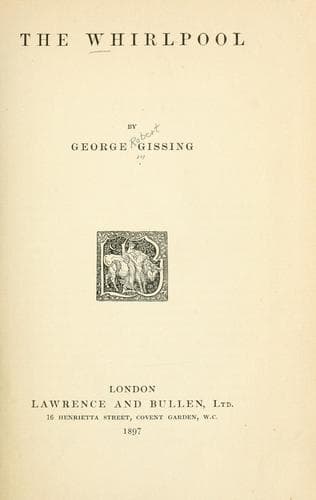
England -- Social life and customs -- 19th century -- Fiction; English fiction -- 19th century
His steps turned to the churchyard, where on a plain upright stone he
read the names of his mother, of his father. Amy's grave was hard by.
He, too, if he had his wish, would some day rest here; and here his own
son would stand, and read his name, and think of him. Ah, but with no
such remorse and self-contempt! That was inconceivable. The tenderness
which dimmed his eyes would have changed to misery had he dreamed it
possible that his own boy could palter so ignobly with the
opportunities of life.
Upon these deep emotions intruded the thought of Alma. Intruded; for he
neither sought nor welcomed his wife's companionship at such a moment,
and he was disturbed by a perception of the little claim she had to be
present with him in spirit. He could no longer pretend to himself that
he loved Alma; whatever the right name for his complex of
feelings--interest, regard, admiration, sexual attachment--assuredly it
must be another word than that sacred to the memory of his parents, to
the desires and hopes centring in his child. For all that, he had no
sense of a hopeless discord in his wedded life; he suffered from no
disillusion, with its attendant bitterness. From this he was saved by
the fact, easy at length to recognise, that in wooing Alma he had
obeyed no dictate of the nobler passion; here, too, as at every other
crisis of life, he had acted on motives which would not bear analysis,
so large was the alloy of mere temperament, of weak concession to
circumstance. Rather than complain that Alma fell short of the ideal in
wifehood, should he not marvel, and be grateful that their marriage
might still be called a happy one? Happiness in marriage is a term of
such vague application: Basil Morton, one in ten thousand, might call
himself happy; even so, all things considered, must the husband who
finds it _just_ possible to endure the contiguity of his wife. Midway
between these extremes of the definition stood Harvey's measure of
matrimonial bliss. He saw that he had no right to grumble.
He saw, moreover, and reflected constantly upon it in these days, how
largely he was himself to blame for the peril of estrangement which
threatened his life with Alma. Meaning well, and thinking himself a
pattern of marital wisdom, he had behaved, as usual, with gross lack of
discretion. The question now was, could he mend the harm that he had
done? Love did not enter into the matter; his difficulty called for
common-sense--for rational methods in behaviour towards a wife whom he
could still respect, and who was closely bound to him by common
interest in their child.
Public-domain text, read in full here on John Shaqi.
Reviews
Reviews
No reviews yet
Be the first to share your thoughts on this work.
Elsewhere in the archive
Join the Discussion
Join the discussion
Sign in to leave a comment or review.
Sign InorCreate an account