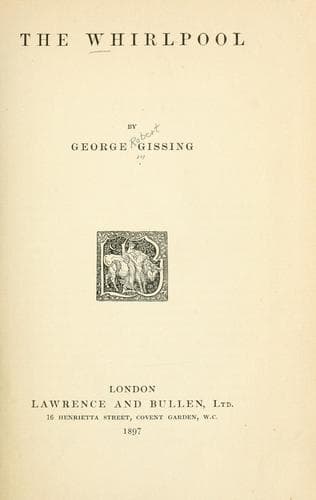
England -- Social life and customs -- 19th century -- Fiction; English fiction -- 19th century
Alma signed herself 'Yours ever affectionately', but Harvey could find
no trace of affection in the letter. It astonished and annoyed him. Of
course, it could have but one explanation; Alma might as well have
saved herself trouble by writing, in a line or two, that she disliked
Mrs. Abbott, and could not bear that the child should be taught by her.
He read through the pages again, and grew angry. What right had she to
make such a request as this, and in the tone of a demand? Twice in the
letter she asserted that she _had_ a right, asserted it as if with some
mysterious reference. Had he sat down immediately to reply, Harvey
would have written briefly forcibly; for, putting aside other grounds
of irritation, there is nothing a man dislikes more than being called
upon at last moment to upset elaborate and troublesome arrangements.
But he was obliged to postpone his answer for a few hours, and in the
meantime he grew more tolerant of Alma's feelings. Had her objection
come earlier, accompanied by the same proposals, he would have been
inclined to listen; but things had gone too far. He wrote, quite
good-temperedly, but without shadow of wavering. There was nothing
sudden, he pointed out, in the step he was about to take; Alma had
known it for months, and had acquiesced in it. As for her music, he
quite agreed with her that she would find it better in every way to
abandon thoughts of a public career; and the fact of Hughie's going to
school for two or three hours a day would in no wise interfere with her
wish to see more of him. What her precise meaning was in saying that
she had some 'right' to make this request, he declared himself unable
to discover. Was it a reproach? If so, his conscience afforded him no
light, and he hoped Alma would explain the words in a letter to him at
Pinner.
This correspondence clouded his last evening at Greystone. He was glad
that some acquaintances of Morton's came, and stayed late; sitting
alone with his friend, he would have been tempted to talk of Alma, and
he felt that silence was better just now.
By a train soon after breakfast next morning, he left the old town,
dearer to him each time that he beheld it, and travelled slowly to the
main-line junction, whence again he travelled slowly to Peterborough.
There the express caught him up, and flung him into roaring London
again. Before going to Pinner, he wished to see Cecil Morphew, for he
had an idea to communicate--a suggestion for the extending of business
by opening correspondence with out of the way towns, such as Greystone.
On reaching the shop in Westminster Bridge Road, he found that Morphew
also had a communication to make, and of a more exciting nature.
CHAPTER 3
Public-domain text, read in full here on John Shaqi.
Reviews
Reviews
No reviews yet
Be the first to share your thoughts on this work.
Elsewhere in the archive
Join the Discussion
Join the discussion
Sign in to leave a comment or review.
Sign InorCreate an account