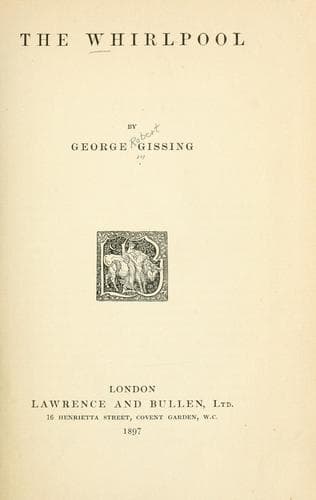
England -- Social life and customs -- 19th century -- Fiction; English fiction -- 19th century
She felt ashamed of herself. In childhood she had told falsehoods
freely, but with the necessity for that kind of thing the habit had
fallen away. Solace, however, was at hand, for the German girl looked
at her with a new interest, a new sympathy, which Alma readily
construed as wonder and admiration, if not gentle envy. To have refused
an offer of marriage from a handsome man of great wealth might be
counted for glory. And Alma's momentary shame yielded to a
gratification which put her outwardly at ease.
The restless night brought torment of the mind and harassed spirits.
Redgrave's proposal echoed in the vacant chambers of her life, sounding
no longer an affront, but an allurement. Why, indeed, had she repelled
it so unthinkingly? It did not necessarily mean scandal. He had not
invited her to open defiance of the world. 'You can absolutely trust
me; I am discretion itself. All resources are at my command.' Why had
she rejected with scorn and horror what was, perhaps, her great
opportunity, the one hope of her struggling and sinking ambition? She
had lost faith in herself; in her power to overcome circumstances, not
yet in her talent, in her artistic birthright. Redgrave would have made
her path smooth. 'I promise you a great reputation in two or three
years' time.' And without disgrace, without shadow of suspicion, it
would all be managed, he declared, so very easily. For what alternative
had she rebuffed him?
Redgrave's sagacity had guided him well up to a certain point, but it
had lost sight of one thing essential to the success of his scheme.
Perhaps because he was forty years of age, perhaps because he had so
often come and seen and conquered, perhaps because he made too low an
estimate of Bennet Frothingham's daughter,--he simply overlooked
sentimental considerations. It was a great and a fatal oversight. He
went far in his calculated appeal to Alma's vanity; had he but credited
her with softer passions, and given himself the trouble to play upon
them, he would not, at all events, have suffered so sudden a defeat.
Men of Redgrave's stamp grow careless, and just at the time of life
when, for various causes, the art which conceals art has become
indispensable. He did not flatter himself that Alma was ready to fall
in love with him; and here his calm maturity served him ill. To his own
defect of ardour he was blinded by habit. After all, the affair had
little consequence. It had only suggested itself after the meeting in
Munich, and perhaps--he said to himself--all things considered, the
event was just as well.
Public-domain text, read in full here on John Shaqi.
Reviews
Reviews
No reviews yet
Be the first to share your thoughts on this work.
Elsewhere in the archive
Join the Discussion
Join the discussion
Sign in to leave a comment or review.
Sign InorCreate an account