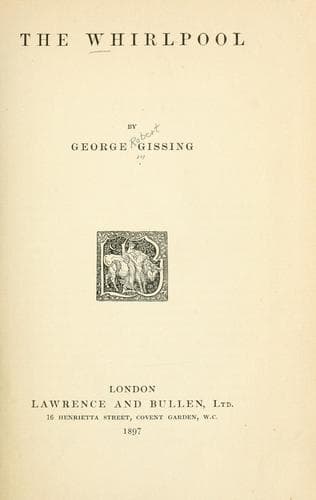
England -- Social life and customs -- 19th century -- Fiction; English fiction -- 19th century
'Can we be simple by wishing it?' asked Alma. 'Don't you think we have
to be born to simplicity?'
'I'm not sure that I know what you mean by the word,' said Harvey.
'I'm not sure that I know myself. Mamma meant poverty, I think. But
there may be a simple life without poverty, I should say. I'm thinking
of disregard for other people's foolish opinions; living just as you
feel most at ease--not torturing yourself because it's the custom.'
'That's just what requires courage,' Rolfe remarked.
'Yes; I suppose it does. One knows people who live in misery just
because they daren't be comfortable; keeping up houses and things they
can't afford, when, if they only considered themselves, their income
would be quite enough for everything they really want. If you come to
think of it, that's too foolish for belief.'
Harvey felt that the topic was growing dangerous. He said nothing, but
wished to have more of Alma's views in this direction. They seemed to
strike her freshly; perhaps she had never thought of the matter in this
way before.
'That's what I meant,' she continued, 'when I said you must be born to
simplicity. I should think no one ever gave up fashionable extravagance
just because they saw it to be foolish. People haven't the strength of
mind. I dare say,' she added, with a bright look, 'anyone who _was_
strong enough to do that kind of thing would be admired and envied.'
'By whom?' Rolfe asked.
'Oh, by their acquaintances who were still slaves.'
'I don't know. Admiration and envy are not commonly excited by merely
reasonable behaviour.'
'But this would be something more than merely reasonable. It would be
the beginning of a revolution.'
'My dear,' remarked Mrs. Frothingham, smiling sadly, 'people would
never believe that it didn't mean loss of money.'
'They might be made to believe it. It would depend entirely on the
persons, of course.'
Alma seemed to weary of the speculation, and to throw it aside. Harvey
noticed a shadow on her face again, which this time did not pass
quickly.
He was so comfortable in his chair, the ladies seemed so entirely at
leisure, such a noiseless calm brooded about them, unbroken by any new
arrival, that two hours went by insensibly, and with lingering
reluctance the visitor found it time to take his leave. On reviewing
the afternoon, Harvey concluded that it was probably as void of meaning
as of event. Alma, on friendly terms once more with her step-mother,
felt for the moment amiably disposed towards everyone, himself
included; this idle good humour and insignificant talk was meant, no
doubt, for an apology, all he had to expect. It implied, of course,
thorough indifference towards him as an individual. As a member of
their shrunken circle, he was worth retaining. Having convinced herself
of his innocence of undue pretensions, Alma would, as the children say,
be friends again, and everything should go smoothly.
Public-domain text, read in full here on John Shaqi.
Reviews
Reviews
No reviews yet
Be the first to share your thoughts on this work.
Elsewhere in the archive
Join the Discussion
Join the discussion
Sign in to leave a comment or review.
Sign InorCreate an account