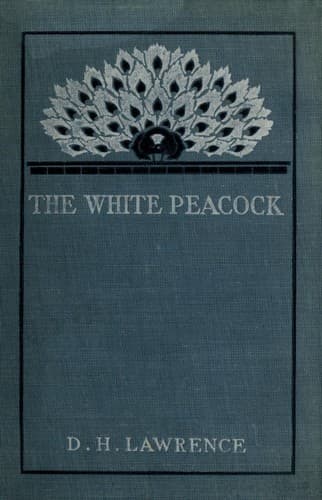
Bildungsromans; Midlands (England) -- Fiction; Young men -- Fiction
He did not answer her; she was too swift for him. They passed on under
the poplars, which were hanging strings of green beads above them.
There was a little open space, with tufts of bluebells. Lettie stooped
over a wood-pigeon that lay on the ground on its breast, its wings half
spread. She took it up—its eyes were bursten and bloody; she felt its
breast, ruffling the dimming iris on its throat.
“It’s been fighting,” he said.
“What for—a mate?” she asked, looking at him.
“I don’t know,” he answered.
“Cold—he’s quite cold, under the feathers! I think a wood-pigeon must
enjoy being fought for—and being won especially if the right one won.
It would be a fine pleasure to see them fighting—don’t you think?” she
said, torturing him.
“The claws are spread—it fell dead off the perch,” he replied.
“Ah, poor thing—it was wounded—and sat and waited for death—when the
other had won. Don’t you think life is very cruel, George—and love the
cruellest of all?”
He laughed bitterly under the pain of her soft, sad tones.
“Let me bury him—and have done with the beaten lover. But we’ll make
him a pretty grave.”
She scooped a hole in the dark soil, and snatching a handful of
bluebells, threw them in on top of the dead bird. Then she smoothed the
soil over all, and pressed her white hands on the black loam.
“There,” she said, knocking her hands one against the other to shake
off the soil, “he’s done with. Come on.”
He followed her, speechless with his emotion.
The spinney opened out; the ferns were serenely uncoiling, the
bluebells stood grouped with blue curls mingled. In the freer spaces
forget-me-nots flowered in nebulæ, and dog-violets gave an undertone
of dark purple, with primroses for planets in the night. There was a
slight drift of woodruff, sweet new-mown hay, scenting the air under
the boughs. On a wet bank was the design of golden saxifrage,
glistening unholily as if varnished by its minister, the snail. George
and Lettie crushed the veined belles of wood-sorrel and broke the
silken mosses. What did it matter to them what they broke or crushed.
Over the fence of the spinney was the hillside, scattered with old
thorn trees. There the little grey lichens held up ruby balls to us
unnoticed. What did it matter, when all the great red apples were being
shaken from the Tree to be left to rot.
“If I were a man,” said Lettie, “I would go out west and be free. I
should love it.”
She took the scarf from her head and let it wave out on the wind; the
colour was warm in her face with climbing, and her curls were freed by
the wind, sparkling and rippling.
“Well—you’re not a man,” he said, looking at her, and speaking with
timid bitterness.
“No,” she laughed, “if I were, I would shape things—oh, wouldn’t I have
my own way!”
“And don’t you now?”
“Oh—I don’t want it particularly—when I’ve got it. When I’ve had my
way, I _do want_ somebody to take it back from me.”
Public-domain text, read in full here on John Shaqi.
Reviews
Reviews
No reviews yet
Be the first to share your thoughts on this work.
Elsewhere in the archive
Join the Discussion
Join the discussion
Sign in to leave a comment or review.
Sign InorCreate an account