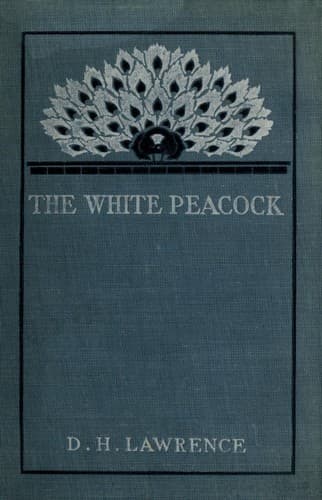
Bildungsromans; Midlands (England) -- Fiction; Young men -- Fiction
I went home to Woodside early in September. Emily was staying at the
Ram. It was strange that everything was so different. Nethermere even
had changed. Nethermere was no longer a complete, wonderful little
world that held us charmed inhabitants. It was a small, insignificant
valley lost in the spaces of the earth. The tree that had drooped over
the brook with such delightful, romantic grace was a ridiculous thing
when I came home after a year of absence in the south. The old symbols
were trite and foolish.
Emily and I went down one morning to Strelley Mill. The house was
occupied by a labourer and his wife, strangers from the north. He was
tall, very thin, and silent, strangely suggesting kinship with the rats
of the place. She was small and very active, like some ragged domestic
fowl run wild. Already Emily had visited her, so she invited us into
the kitchen of the mill, and set forward the chairs for us. The large
room had the barren air of a cell. There was a small table stranded
towards the fireplace, and a few chairs by the walls; for the rest,
desert spaces of flagged floor retreating into shadow. On the walls by
the windows were five cages of canaries, and the small sharp movements
of the birds made the room more strange in its desolation. When we
began to talk the birds began to sing, till we were quite bewildered,
for the little woman spoke Glasgow Scotch, and she had a hare lip. She
rose and ran toward the cages, crying herself like some wild fowl, and
flapping a duster at the warbling canaries.
“Stop it, stop it!” she cried, shaking her thin weird body at them.
“Silly little devils, fools, fools, fools!!” and she flapped the duster
till the birds were subdued. Then she brought us delicious scones and
apple jelly, urging us, almost nudging us with her thin elbows to make
us eat.
“Don’t you like ’em, don’t you? Well eat ’em, eat ’em then. Go on
Emily, go on, eat some more. Only don’t tell Tom—don’t tell Tom when ’e
comes in,”—she shook her head and laughed her shrilling, weird
laughter.
As we were going she came out with us, and went running on in front. We
could not help noting how ragged and unkempt was her short black skirt.
But she hastened around us, hither and thither like an excited fowl,
talking in her high-pitched, unintelligible manner. I could not believe
the brooding mill was in her charge. I could not think this was the
Strelley Mill of a year ago. She fluttered up the steep orchard bank in
front of us. Happening to turn round and see Emily and me smiling at
each other she began to laugh her strident, weird laughter saying, with
a leer:
“Emily, he’s your sweetheart, your sweetheart Emily! You never told
me!” and she laughed aloud.
We blushed furiously. She came away from the edge of the sluice gully,
nearer to us, crying:
“You’ve been here o’ nights, haven’t you Emily—haven’t you?” and she
laughed again. Then she sat down suddenly, and pointing above our
heads, shrieked:
Public-domain text, read in full here on John Shaqi.
Reviews
Reviews
No reviews yet
Be the first to share your thoughts on this work.
Elsewhere in the archive
Join the Discussion
Join the discussion
Sign in to leave a comment or review.
Sign InorCreate an account