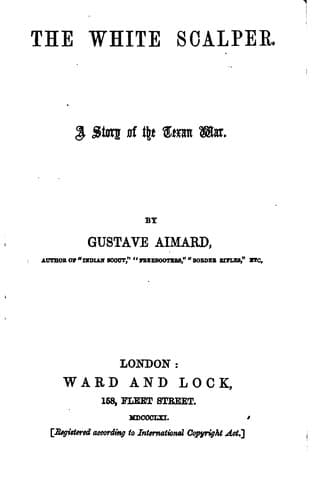
The White Scalper: A Story of the Texan WarAimard, Gustave
History
The White Scalper: A Story of the Texan War
Aimard, Gustave
Texas -- History -- Revolution, 1835-1836 -- Fiction; Western stories
"I know not what I felt on seeing this, or what dizziness seized upon
me, but, by a mechanical movement, I raised my rifle and fired; then,
rushing into the clearing with loud cries, I discharged my pistols at
the men nearest me. An extraordinary thing occurred, which I was far
from expecting, and certainly had not foreseen. The Indians, terrified
by my three shots, followed by my sudden apparition, believed that help
was arriving to their adversaries, and without dreaming of resisting,
they began flying with that intuitive rapidity peculiar to Indians, at
the first repulse they meet with.
"I thus found myself alone with those I came to deliver. It was the
first time I had been engaged in a fight, if such a name can be given to
the share I took in the struggle, hence I felt that emotion inseparable
from a first event of this nature; I neither saw nor heard anything. I
was standing in the centre of the clearing, like a statue, not knowing
whether to advance or retire, flanked by my two bloodhounds, which had
not left me, but showed their teeth with hoarse growls of anger.
"I know not who was the first to say that ingratitude was a white vice,
and gratitude an Indian virtue; but, whoever he was, he spoke the truth.
The Chief I had so miraculously saved, and his comrades, pressed around
me, and began overwhelming me with marks of respect and gratitude. I let
them do so, mechanically replying as well as I could, in Spanish, to the
compliments the Indians lavished on me in their sonorous language, of
which I did not understand a syllable. When a little while had elapsed,
and their joy was beginning to grow more sedate, the Chief, who had been
slightly wounded in the fight, made me sit down by the fire; while his
comrades conscientiously raised the scalps of their enemy who had
fallen, and he began questioning me in Spanish, which language he spoke
clearly.
"After warmly thanking me, and repeating several times that I was a
great brave, he told me that his name was Nocobotha, that is to say, the
Tempest; that he belonged to the great and powerful nation of the
Comanches, surnamed the Queen of the Prairies, and was related to a
renowned Sachem called Black-deer. Having set out with a few warriors to
chase antelopes, he had been surprised by a detachment of Apaches, the
sworn enemies of his nation, and if the Master of Life had not brought
me to their help, he and his comrades would infallibly have succumbed,
an opinion the justice of which I was compelled to recognise. The Chief
then asked me who I was, saying to me that he should henceforth regard
me as his brother, that he wished to conduct me to his tribe, and that
he would never consent to separate from the man who had saved his life.
Public-domain text, read in full here on John Shaqi.
Reviews
Reviews
No reviews yet
Be the first to share your thoughts on this work.
Elsewhere in the archive
Join the Discussion
Join the discussion
Sign in to leave a comment or review.
Sign InorCreate an account