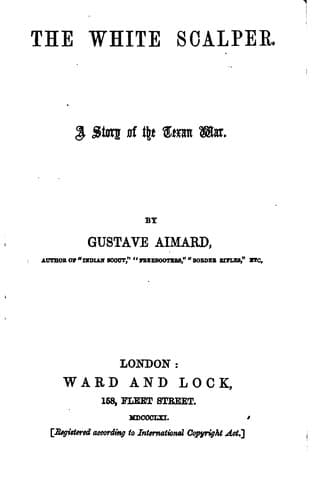
The White Scalper: A Story of the Texan WarAimard, Gustave
History
The White Scalper: A Story of the Texan War
Aimard, Gustave
Texas -- History -- Revolution, 1835-1836 -- Fiction; Western stories
In truth, the formidable Chief lay on a pile of Comanche corpses; his
body was literally covered with wounds, and his son, a poor lad scarce
adolescent yet, was lying at his feet. Curiously enough, for the Indians
only take the scalps of their enemies usually, a fresh cut-off head was
fastened to the Chiefs girdle--it was that of Fray Antonio. The poor
Monk, who had quitted the village a few days before Tranquil, had
doubtless been surprised and massacred by the Apaches.
So soon as the carnage, for we cannot call it a battle, was over, the
Indians prepared to pay the last rites to those of their friends who had
found death in this sanguinary struggle. Deep graves were dug, and the
bodies were thrown in without the usual funeral ceremonies, which
circumstances prevented, still they were careful to bury their arms with
them, and then stones were piled on the graves to defend them from wild
beasts. As for the Apaches, they were left at the spot where they had
fallen. After this, the war party, diminished by nearly one-half,
started again sadly for Texas.
The victory of the Comanches was complete, it is true, but too dearly
bought for the Indians to think of rejoicing at it. The massacre of the
Apaches was far from compensating them for the death of forty Comanche
warriors, without counting those who, in all probability, would perish
on the journey from the wounds they had received.
CHAPTER XXV.
THE LAST HALT.
Now that we are approaching the last pages of our book, we cannot
repress a feeling of regret on thinking of the scenes of blood and
murder which, in order to be truthful, we were compelled to unfold
before our readers. If this narrative had been a fable, and we had been
able to arrange our subject at our pleasure, most assuredly many scenes
would have been cut down and altered. Unhappily, we have been obliged to
narrate facts just as they happened, although we have frequently been
careful to tone down certain details whose naked truth would have
scandalized the reader.
Were we to be reproached with the continual combats in which our heroes
are engaged, we should reply; we describe the manners of a race which is
daily diminishing in the convulsive grasp of the civilization against
which it struggles in vain; this race is called upon by the fatal decree
of fate to disappear ere long eternally from the face of the globe; its
manners and customs will then pass into the condition of a legend and
being preserved by tradition, will not fail to be falsified and become
incomprehensible. It is therefore our duty, who have become the unworthy
historian of this unhappy race, to make it known as it was, as it is
still, for acting otherwise would have been a felonious deed on our
part, of which our readers would have been justified in complaining.
Finishing this parenthesis, which is already too long, but which we
believe to be not merely necessary but indispensable, we will resume
our narrative at the point where we left it.
Public-domain text, read in full here on John Shaqi.
Reviews
Reviews
No reviews yet
Be the first to share your thoughts on this work.
Elsewhere in the archive
Join the Discussion
Join the discussion
Sign in to leave a comment or review.
Sign InorCreate an account