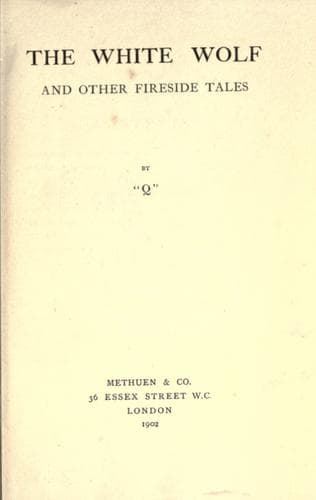
The White Wolf and Other Fireside TalesQuiller-Couch, Arthur
Science
The White Wolf and Other Fireside Tales
Quiller-Couch, Arthur
Short stories, English
I daresay they never saw, and perhaps never will see, one another.
I met them on separate railway journeys, and the dates are divided by
five years almost. One boy was travelling third-class, the other first.
The age of each when I made his very slight acquaintance (with the one I
did not even exchange a word) was about fourteen. Almost certainly
their lives and their stories have no connection outside of my thoughts.
But I think of them often, and together. They have grown up; the
younger will be a man by this time; if I met them now, their altered
faces would probably be quite strange to me. Yet the two boys remain my
friends, and that is why I take leave to include them among these
stories of my friends.
I.
The first boy (I never heard his name) was seated in the third-class
smoking-carriage when I joined my train at Plymouth; seated beside his
mother, an over-heated countrywoman in a state of subsiding fussiness.
We had a good five minutes to wait, but, as such women always will, she
had made a bolt for the first door within reach. Of course she found
herself in a smoking compartment, and of course she disliked tobacco,
but could not, although she made two false starts, make up her mind to
change. She had dropped upon one of the middle seats and dragged her
boy down into the next, thus leaving me the only vacant corner.
The others were occupied by a couple of drovers and a middle-aged man
with a newspaper, which he read column by column, advertisements and
all, without raising his eyes for a moment.
The guard just outside the carriage door had his whistle to his lips,
and his green flag lifted ready to wave, when the woman asked--
"Can anyone tell me if this train goes to London?"
The drovers and I assured her that it did.
"It stops at Bristol, doesn't it? My ticket is for Bristol."
The train was in motion by this time. We set her mind at ease.
She opened a limp basket (called a "frail" I believe), produced an apple
and offered it to the boy. He shook his head.
He was a passably good-looking coltish boy, in a best suit which he had
outgrown, and a hard black hat, the brim of which annoyed him when he
leaned back. A binding of black braid advertised what it was meant to
conceal--that the cuffs of his jacket had been lengthened; yet as he sat
with his hands crossed in his lap he displayed a deal of wrist.
Public-domain text, read in full here on John Shaqi.
Reviews
Reviews
No reviews yet
Be the first to share your thoughts on this work.
Elsewhere in the archive
Join the Discussion
Join the discussion
Sign in to leave a comment or review.
Sign InorCreate an account