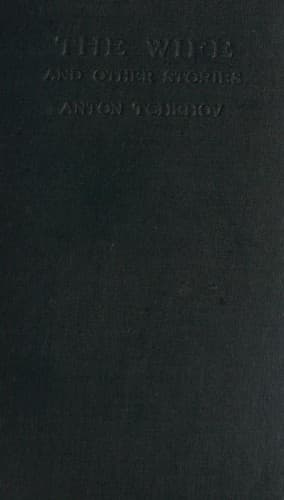
The Wife, and Other StoriesChekhov, Anton Pavlovich
General
The Wife, and Other Stories
Chekhov, Anton Pavlovich
Chekhov, Anton Pavlovich, 1860-1904 -- Translations into English; Russia -- Social life and customs -- Fiction; Short stories
“You are a very good man, Nikolay Stepanovitch,” she says. “You are a
rare specimen, and there isn’t an actor who would understand how to play
you. Me or Mihail Fyodorovitch, for instance, any poor actor could do,
but not you. And I envy you, I envy you horribly! Do you know what I
stand for? What?”
She ponders for a minute, and then asks me:
“Nikolay Stepanovitch, I am a negative phenomenon! Yes?”
“Yes,” I answer.
“H’m! what am I to do?”
What answer was I to make her? It is easy to say “work,” or “give your
possessions to the poor,” or “know yourself,” and because it is so easy
to say that, I don’t know what to answer.
My colleagues when they teach therapeutics advise “the individual study
of each separate case.” One has but to obey this advice to gain the
conviction that the methods recommended in the textbooks as the best and
as providing a safe basis for treatment turn out to be quite unsuitable
in individual cases. It is just the same in moral ailments.
But I must make some answer, and I say:
“You have too much free time, my dear; you absolutely must take up some
occupation. After all, why shouldn’t you be an actress again if it is
your vocation?”
“I cannot!”
“Your tone and manner suggest that you are a victim. I don’t like that,
my dear; it is your own fault. Remember, you began with falling out with
people and methods, but you have done nothing to make either better. You
did not struggle with evil, but were cast down by it, and you are not
the victim of the struggle, but of your own impotence. Well, of course
you were young and inexperienced then; now it may all be different. Yes,
really, go on the stage. You will work, you will serve a sacred art.”
“Don’t pretend, Nikolay Stepanovitch,” Katya interrupts me. “Let us
make a compact once for all; we will talk about actors, actresses, and
authors, but we will let art alone. You are a splendid and rare person,
but you don’t know enough about art sincerely to think it sacred. You
have no instinct or feeling for art. You have been hard at work all your
life, and have not had time to acquire that feeling. Altogether... I
don’t like talk about art,” she goes on nervously. “I don’t like it!
And, my goodness, how they have vulgarized it!”
“Who has vulgarized it?”
“They have vulgarized it by drunkenness, the newspapers by their
familiar attitude, clever people by philosophy.”
“Philosophy has nothing to do with it.”
“Yes, it has. If any one philosophizes about it, it shows he does not
understand it.”
To avoid bitterness I hasten to change the subject, and then sit a
long time silent. Only when we are driving out of the wood and turning
towards Katya’s villa I go back to my former question, and say:
“You have still not answered me, why you don’t want to go on the stage.”
Public-domain text, read in full here on John Shaqi.
Reviews
Reviews
No reviews yet
Be the first to share your thoughts on this work.
Elsewhere in the archive
Join the Discussion
Join the discussion
Sign in to leave a comment or review.
Sign InorCreate an account