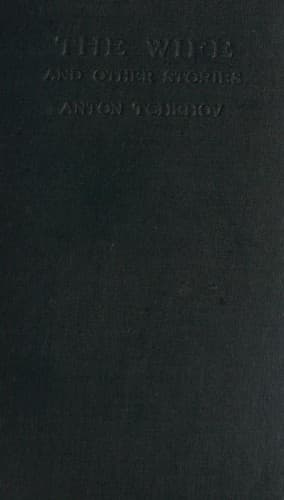
The Wife, and Other StoriesChekhov, Anton Pavlovich
General
The Wife, and Other Stories
Chekhov, Anton Pavlovich
Chekhov, Anton Pavlovich, 1860-1904 -- Translations into English; Russia -- Social life and customs -- Fiction; Short stories
“I was unhappy. At home, in the fields, in the barn, I thought of her;
I tried to understand the mystery of a beautiful, intelligent young
woman’s marrying some one so uninteresting, almost an old man (her
husband was over forty), and having children by him; to understand the
mystery of this uninteresting, good, simple-hearted man, who argued with
such wearisome good sense, at balls and evening parties kept near the
more solid people, looking listless and superfluous, with a submissive,
uninterested expression, as though he had been brought there for sale,
who yet believed in his right to be happy, to have children by her; and
I kept trying to understand why she had met him first and not me, and
why such a terrible mistake in our lives need have happened.
“And when I went to the town I saw every time from her eyes that she
was expecting me, and she would confess to me herself that she had had
a peculiar feeling all that day and had guessed that I should come. We
talked a long time, and were silent, yet we did not confess our love to
each other, but timidly and jealously concealed it. We were afraid
of everything that might reveal our secret to ourselves. I loved her
tenderly, deeply, but I reflected and kept asking myself what our love
could lead to if we had not the strength to fight against it. It seemed
to be incredible that my gentle, sad love could all at once coarsely
break up the even tenor of the life of her husband, her children, and
all the household in which I was so loved and trusted. Would it be
honourable? She would go away with me, but where? Where could I take
her? It would have been a different matter if I had had a beautiful,
interesting life--if, for instance, I had been struggling for the
emancipation of my country, or had been a celebrated man of science,
an artist or a painter; but as it was it would mean taking her from one
everyday humdrum life to another as humdrum or perhaps more so. And how
long would our happiness last? What would happen to her in case I was
ill, in case I died, or if we simply grew cold to one another?
“And she apparently reasoned in the same way. She thought of her
husband, her children, and of her mother, who loved the husband like a
son. If she abandoned herself to her feelings she would have to lie,
or else to tell the truth, and in her position either would have been
equally terrible and inconvenient. And she was tormented by the question
whether her love would bring me happiness--would she not complicate
my life, which, as it was, was hard enough and full of all sorts of
trouble? She fancied she was not young enough for me, that she was not
industrious nor energetic enough to begin a new life, and she often
talked to her husband of the importance of my marrying a girl of
intelligence and merit who would be a capable housewife and a help to
me--and she would immediately add that it would be difficult to find
such a girl in the whole town.
Public-domain text, read in full here on John Shaqi.
Reviews
Reviews
No reviews yet
Be the first to share your thoughts on this work.
Elsewhere in the archive
Join the Discussion
Join the discussion
Sign in to leave a comment or review.
Sign InorCreate an account