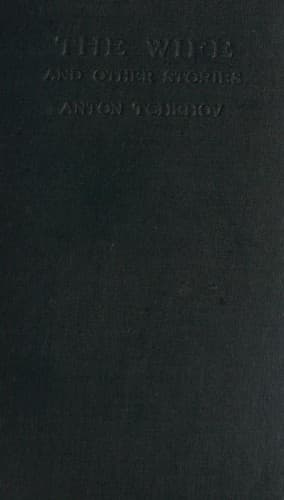
The Wife, and Other StoriesChekhov, Anton Pavlovich
General
The Wife, and Other Stories
Chekhov, Anton Pavlovich
Chekhov, Anton Pavlovich, 1860-1904 -- Translations into English; Russia -- Social life and customs -- Fiction; Short stories
Varya and Liza both hate Katya. This hatred is beyond my comprehension,
and probably one would have to be a woman in order to understand it. I
am ready to stake my life that of the hundred and fifty young men I see
every day in the lecture-theatre, and of the hundred elderly ones I meet
every week, hardly one could be found capable of understanding their
hatred and aversion for Katya’s past--that is, for her having been a
mother without being a wife, and for her having had an illegitimate
child; and at the same time I cannot recall one woman or girl of my
acquaintance who would not consciously or unconsciously harbour such
feelings. And this is not because woman is purer or more virtuous than
man: why, virtue and purity are not very different from vice if they are
not free from evil feeling. I attribute this simply to the backwardness
of woman. The mournful feeling of compassion and the pang of conscience
experienced by a modern man at the sight of suffering is, to my mind,
far greater proof of culture and moral elevation than hatred and
aversion. Woman is as tearful and as coarse in her feelings now as she
was in the Middle Ages, and to my thinking those who advise that she
should be educated like a man are quite right.
My wife also dislikes Katya for having been an actress, for ingratitude,
for pride, for eccentricity, and for the numerous vices which one woman
can always find in another.
Besides my wife and daughter and me, there are dining with us two or
three of my daughter’s friends and Alexandr Adolfovitch Gnekker, her
admirer and suitor. He is a fair-haired young man under thirty, of
medium height, very stout and broad-shouldered, with red whiskers near
his ears, and little waxed moustaches which make his plump smooth face
look like a toy. He is dressed in a very short reefer jacket, a flowered
waistcoat, breeches very full at the top and very narrow at the ankle,
with a large check pattern on them, and yellow boots without heels. He
has prominent eyes like a crab’s, his cravat is like a crab’s neck, and
I even fancy there is a smell of crab-soup about the young man’s whole
person. He visits us every day, but no one in my family knows anything
of his origin nor of the place of his education, nor of his means of
livelihood. He neither plays nor sings, but has some connection with
music and singing, sells somebody’s pianos somewhere, is frequently
at the Conservatoire, is acquainted with all the celebrities, and is a
steward at the concerts; he criticizes music with great authority, and I
have noticed that people are eager to agree with him.
Public-domain text, read in full here on John Shaqi.
Reviews
Reviews
No reviews yet
Be the first to share your thoughts on this work.
Elsewhere in the archive
Join the Discussion
Join the discussion
Sign in to leave a comment or review.
Sign InorCreate an account