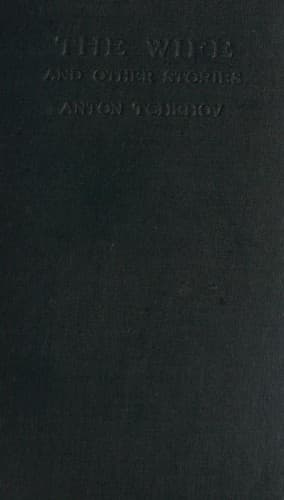
The Wife, and Other StoriesChekhov, Anton Pavlovich
General
The Wife, and Other Stories
Chekhov, Anton Pavlovich
Chekhov, Anton Pavlovich, 1860-1904 -- Translations into English; Russia -- Social life and customs -- Fiction; Short stories
To describe our dinner nowadays is as uninteresting as to eat it.
My wife’s face wears a look of triumph and affected dignity, and her
habitual expression of anxiety. She looks at our plates and says, “I see
you don’t care for the joint. Tell me; you don’t like it, do you?” and I
am obliged to answer: “There is no need for you to trouble, my dear;
the meat is very nice.” And she will say: “You always stand up for me,
Nikolay Stepanovitch, and you never tell the truth. Why is Alexandr
Adolfovitch eating so little?” And so on in the same style all through
dinner. Liza laughs spasmodically and screws up her eyes. I watch them
both, and it is only now at dinner that it becomes absolutely evident
to me that the inner life of these two has slipped away out of my ken.
I have a feeling as though I had once lived at home with a real wife and
children and that now I am dining with visitors, in the house of a sham
wife who is not the real one, and am looking at a Liza who is not the
real Liza. A startling change has taken place in both of them; I have
missed the long process by which that change was effected, and it is no
wonder that I can make nothing of it. Why did that change take place? I
don’t know. Perhaps the whole trouble is that God has not given my wife
and daughter the same strength of character as me. From childhood I
have been accustomed to resisting external influences, and have steeled
myself pretty thoroughly. Such catastrophes in life as fame, the rank
of a general, the transition from comfort to living beyond our means,
acquaintance with celebrities, etc., have scarcely affected me, and I
have remained intact and unashamed; but on my wife and Liza, who have
not been through the same hardening process and are weak, all this has
fallen like an avalanche of snow, overwhelming them. Gnekker and the
young ladies talk of fugues, of counterpoint, of singers and pianists,
of Bach and Brahms, while my wife, afraid of their suspecting her of
ignorance of music, smiles to them sympathetically and mutters: “That’s
exquisite... really! You don’t say so!...” Gnekker eats with solid
dignity, jests with solid dignity, and condescendingly listens to the
remarks of the young ladies. From time to time he is moved to speak in
bad French, and then, for some reason or other, he thinks it necessary
to address me as _“Votre Excellence.”_
Public-domain text, read in full here on John Shaqi.
Reviews
Reviews
No reviews yet
Be the first to share your thoughts on this work.
Elsewhere in the archive
Join the Discussion
Join the discussion
Sign in to leave a comment or review.
Sign InorCreate an account