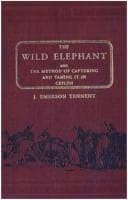
The Wild Elephant and the Method of Capturing and Taming it in CeylonTennent, James Emerson, Sir
History
The Wild Elephant and the Method of Capturing and Taming it in Ceylon
Tennent, James Emerson, Sir
Elephants -- Sri Lanka
If surprised in open ground, where stealthy retreat is impracticable,
a herd will hesitate in indecision, and, after a few meaningless
movements, stand huddled together in a group, whilst one or two,
more adventurous than the rest, advance a few steps to reconnoitre.
Elephants are generally observed to be bolder in open ground than in
cover, but, if bold at all, far more dangerous in cover than in open
ground.
In searching for them, sportsmen often avail themselves of the
expertness of the native trackers; and notwithstanding the
demonstration of Combe that the brain of the timid Singhalese is
deficient in the organ of destructiveness,[111] he shows an instinct
for hunting, and exhibits in the pursuit of the elephant a courage
and adroitness far surpassing in interest the mere handling of the
rifle, which is the principal share of the proceeding that falls to his
European companions.
The beater on these occasions has the double task of finding the
game and carrying the guns; and, in an animated communication to me,
an experienced sportsman describes “this light and active creature,
with his long glossy hair hanging down his shoulders, every muscle
quivering with excitement; and his countenance lighting up with intense
animation, leaping from rock to rock, as nimble as a chamois, tracking
the gigantic game like a blood-hound, falling behind as he comes up
with it, and as the elephants, baffled and irritated, make the first
stand, passing one rifle into your eager hand and holding the other
ready whilst right and left each barrel performs its mission, and if
fortune does not flag, and the second gun is as successful as the
first, three or four huge carcases are piled one on another within a
space equal to the area of a dining room.”[112]
It is curious that in these encounters the herd never rush forward
in a body, as buffaloes or bisons do, but only one elephant at a time
moves in advance of the rest to confront, or, as it is called, to
“charge,” the assailants. I have heard of but one instance in which
_two_ so advanced as champions of their companions. Sometimes, indeed,
the whole herd will follow a leader, and manœuvre in his rear like a
body of cavalry; but so large a party are necessarily liable to panic;
and, one of them having turned in alarm, the entire body retreat with
terrified precipitation.
As regards boldness and courage, a strange variety of temperament is
observable amongst elephants, but it may be affirmed that they are much
more generally timid than courageous. One herd may be as difficult to
approach as deer, gliding away through the jungle so gently and quickly
that scarcely a trace marks their passage; another, in apparent stupor,
will huddle themselves together like swine, and allow their assailant
to come within a few yards before they break away in terror; and a
third will await his approach without motion, and then advance with
fury to the “charge.”
Public-domain text, read in full here on John Shaqi.
Reviews
Reviews
No reviews yet
Be the first to share your thoughts on this work.
Elsewhere in the archive
Join the Discussion
Join the discussion
Sign in to leave a comment or review.
Sign InorCreate an account