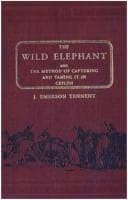
The Wild Elephant and the Method of Capturing and Taming it in CeylonTennent, James Emerson, Sir
History
The Wild Elephant and the Method of Capturing and Taming it in Ceylon
Tennent, James Emerson, Sir
Elephants -- Sri Lanka
The love of the elephant for coolness and shade renders it at all
times more or less impatient of work in the sun, and every moment of
leisure it can snatch is employed in covering its back with dust, or
fanning itself to diminish the annoyance of the insects and heat. From
the tenderness of the skin and its liability to sores, the labour in
which the elephant can most advantageously be employed is that of
draught; but the reluctance of horses to meet or pass them renders it
difficult to work them with safety on frequented roads. Besides, were
the full load which an elephant is capable of drawing, proportionally
to its muscular strength, to be placed upon waggons of corresponding
dimension, the injury to roads from the extra weight would be such
that the wear and tear of the highways and bridges would prove too
costly to be borne. On the other hand, by restricting it to a somewhat
more manageable quantity, and by limiting the weight, as at present, to
about _one ton and a half_, it is doubtful whether an elephant performs
so much more work than could be done by a horse or by bullocks, as to
compensate for the greater cost of his feeding and attendance.
Add to this, that from accidents and other causes, from ulcerations
of the skin, and illnesses of many kinds, the elephant is so often
invalided, that the actual cost of its labour, when at work, is very
considerably enhanced. Exclusive of the salaries of higher officers
attached to the Government establishments, and other permanent
charges, the expenses of an elephant, looking only to the wages of
its attendants and the cost of its food and medicines, varies from
_three shillings to four shillings and sixpence_ per diem, according
to its size and class.[163] Taking the average at three shillings
and nine-pence, and calculating that hardly any individual works
more than four days out of seven, the charge for each day so employed
would amount to _six shillings and sixpence_. The keep per day of a
powerful dray-horse, working five days in the week, would not exceed
half-a-crown, and two such would unquestionably do more work than any
elephant under the present system. I do not know whether it be from a
comparative calculation of this kind that the strength of the elephant
establishments in Ceylon has been gradually diminished of late years,
but in the department of the Commissioner of Roads, the stud, which
formerly numbered upwards of sixty elephants, was reduced, some years
ago, to thirty-six, and is at present less than half that number.
Public-domain text, read in full here on John Shaqi.
Reviews
Reviews
No reviews yet
Be the first to share your thoughts on this work.
Elsewhere in the archive
Join the Discussion
Join the discussion
Sign in to leave a comment or review.
Sign InorCreate an account