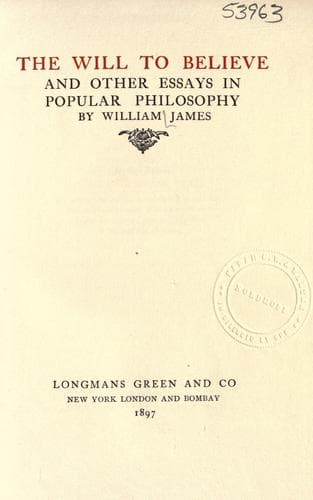
The Will to Believe, and Other Essays in Popular PhilosophyJames, William
Religion
The Will to Believe, and Other Essays in Popular Philosophy
James, William
Belief and doubt; Essays; Philosophy
It is this empirical and practical side of the theistic position, its
theoretic chastity and modesty, which I {136} wish to accentuate here.
The highest flights of theistic mysticism, far from pretending to
penetrate the secrets of the _me_ and the _thou_ in worship, and to
transcend the dualism by an act of intelligence, simply turn their
backs on such attempts. The problem for them has simply
vanished,--vanished from the sight of an attitude which refuses to
notice such futile theoretic difficulties. Get but that "peace of God
which passeth understanding," and the questions of the understanding
will cease from puzzling and pedantic scruples be at rest. In other
words, theistic mysticism, that form of theism which at first sight
seems most to have transcended the fundamental otherness of God from
man, has done it least of all in the theoretic way. The pattern of its
procedure is precisely that of the simplest man dealing with the
simplest fact of his environment. Both he and the theist tarry in
department Two of their minds only so long as is necessary to define
what is the presence that confronts them. The theist decides that its
character is such as to be fitly responded to on his part by a
religious reaction; and into that reaction he forthwith pours his soul.
His insight into the _what_ of life leads to results so immediately and
intimately rational that the _why_, the _how_, and the _whence_ of it
are questions that lose all urgency. 'Gefühl ist Alles,' Faust says.
The channels of department Three have drained those of department Two
of their contents; and happiness over the fact that being has made
itself what it is, evacuates all speculation as to how it could make
itself at all.
But now, although to most human minds such a position as this will be
the position of rational equilibrium, it is not difficult to bring
forward certain {137} considerations, in the light of which so simple
and practical a mental movement begins to seem rather short-winded and
second-rate and devoid of intellectual style. This easy acceptance of
an opaque limit to our speculative insight; this satisfaction with a
Being whose character we simply apprehend without comprehending
anything more about him, and with whom after a certain point our
dealings can be only of a volitional and emotional sort; above all,
this sitting down contented with a blank unmediated dualism,--are they
not the very picture of unfaithfulness to the rights and duties of our
theoretic reason?
Public-domain text, read in full here on John Shaqi.
Reviews
Reviews
No reviews yet
Be the first to share your thoughts on this work.
Elsewhere in the archive
Join the Discussion
Join the discussion
Sign in to leave a comment or review.
Sign InorCreate an account