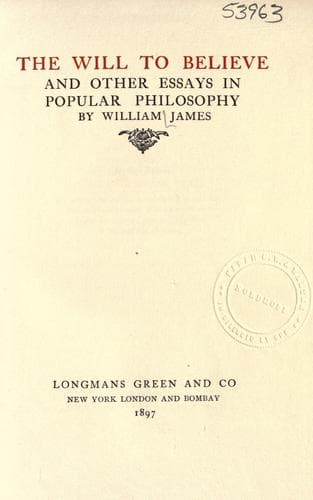
The Will to Believe, and Other Essays in Popular PhilosophyJames, William
Religion
The Will to Believe, and Other Essays in Popular Philosophy
James, William
Belief and doubt; Essays; Philosophy
"Fool! had that bough a pumpkin bore,
Thy whimsies would have worked no more," etc.
Even from the point of view of our own ends, we should probably make a
botch of remodelling the universe. How much more then from the point
of view of ends we cannot see! Wise men therefore regret as little as
they can. But still some regrets are pretty obstinate and hard to
stifle,--regrets for acts of wanton cruelty or treachery, for example,
whether performed by others or by ourselves. Hardly any one can remain
_entirely_ optimistic after reading the confession of the murderer at
Brockton the other day: how, to get rid of the wife whose continued
existence bored him, he inveigled her into a desert spot, shot her four
times, and then, as she lay on the ground and said to him, "You didn't
do it on purpose, did you, dear?" replied, "No, I {161} didn't do it on
purpose," as he raised a rock and smashed her skull. Such an
occurrence, with the mild sentence and self-satisfaction of the
prisoner, is a field for a crop of regrets, which one need not take up
in detail. We feel that, although a perfect mechanical fit to the rest
of the universe, it is a bad moral fit, and that something else would
really have been better in its place.
But for the deterministic philosophy the murder, the sentence, and the
prisoner's optimism were all necessary from eternity; and nothing else
for a moment had a ghost of a chance of being put into their place. To
admit such a chance, the determinists tell us, would be to make a
suicide of reason; so we must steel our hearts against the thought.
And here our plot thickens, for we see the first of those difficult
implications of determinism and monism which it is my purpose to make
you feel. If this Brockton murder was called for by the rest of the
universe, if it had to come at its preappointed hour, and if nothing
else would have been consistent with the sense of the whole, what are
we to think of the universe? Are we stubbornly to stick to our
judgment of regret, and say, though it _couldn't_ be, yet it _would_
have been a better universe with something different from this Brockton
murder in it? That, of course, seems the natural and spontaneous thing
for us to do; and yet it is nothing short of deliberately espousing a
kind of pessimism. The judgment of regret calls the murder bad.
Calling a thing bad means, if it mean anything at all, that the thing
ought not to be, that something else ought to be in its stead.
Determinism, in denying that anything else can be in its stead,
virtually defines the universe {162} as a place in which what ought to
be is impossible,--in other words, as an organism whose constitution is
afflicted with an incurable taint, an irremediable flaw. The pessimism
of a Schopenhauer says no more than this,--that the murder is a
symptom; and that it is a vicious symptom because it belongs to a
vicious whole, which can express its nature no otherwise than by
Public-domain text, read in full here on John Shaqi.
Reviews
Reviews
No reviews yet
Be the first to share your thoughts on this work.
Elsewhere in the archive
Join the Discussion
Join the discussion
Sign in to leave a comment or review.
Sign InorCreate an account