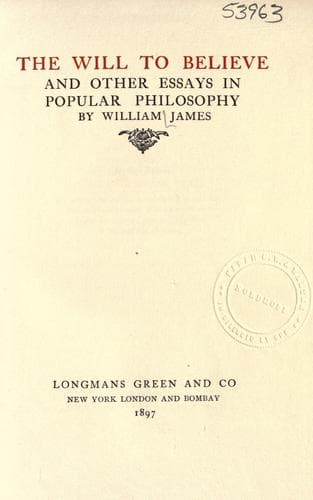
The Will to Believe, and Other Essays in Popular PhilosophyJames, William
Religion
The Will to Believe, and Other Essays in Popular Philosophy
James, William
Belief and doubt; Essays; Philosophy
The refuge from the quandary lies, as I said, not far off. The
necessary acts we erroneously regret {165} may be good, and yet our
error in so regretting them may be also good, on one simple condition;
and that condition is this: The world must not be regarded as a machine
whose final purpose is the making real of any outward good, but rather
as a contrivance for deepening the theoretic consciousness of what
goodness and evil in their intrinsic natures are. Not the doing either
of good or of evil is what nature cares for, but the knowing of them.
Life is one long eating of the fruit of the tree of _knowledge_. I am
in the habit, in thinking to myself, of calling this point of view the
_gnostical_ point of view. According to it, the world is neither an
optimism nor a pessimism, but a _gnosticism_. But as this term may
perhaps lead to some misunderstandings, I will use it as little as
possible here, and speak rather of _subjectivism_, and the
_subjectivistic_ point of view.
Subjectivism has three great branches,--we may call them scientificism,
sentimentalism, and sensualism, respectively. They all agree
essentially about the universe, in deeming that what happens there is
subsidiary to what we think or feel about it. Crime justifies its
criminality by awakening our intelligence of that criminality, and
eventually our remorses and regrets; and the error included in remorses
and regrets, the error of supposing that the past could have been
different, justifies itself by its use. Its use is to quicken our
sense of _what_ the irretrievably lost is. When we think of it as that
which might have been ('the saddest words of tongue or pen'), the
quality of its worth speaks to us with a wilder sweetness; and,
conversely, the dissatisfaction wherewith we think of what seems to
have driven it from its natural place gives us the severer pang.
Admirable artifice of {166} nature! we might be tempted to
exclaim,--deceiving us in order the better to enlighten us, and leaving
nothing undone to accentuate to our consciousness the yawning distance
of those opposite poles of good and evil between which creation swings.
Public-domain text, read in full here on John Shaqi.
Reviews
Reviews
No reviews yet
Be the first to share your thoughts on this work.
Elsewhere in the archive
Join the Discussion
Join the discussion
Sign in to leave a comment or review.
Sign InorCreate an account