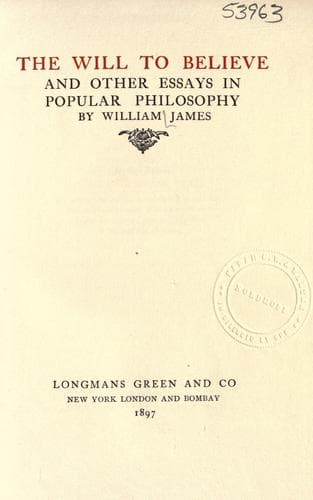
The Will to Believe, and Other Essays in Popular PhilosophyJames, William
Religion
The Will to Believe, and Other Essays in Popular Philosophy
James, William
Belief and doubt; Essays; Philosophy
Well, I admit there may be just a dash of perversity in its choice.
The spectacle of the mere word-grabbing game played by the soft
determinists has perhaps driven me too violently the other way; and,
rather than be found wrangling with them for the good words, I am
willing to take the first bad one which comes along, provided it be
unequivocal. The question is of things, not of eulogistic names for
them; and the best word is the one that enables men to {180} know the
quickest whether they disagree or not about the things. But the word
'chance,' with its singular negativity, is just the word for this
purpose. Whoever uses it instead of 'freedom,' squarely and resolutely
gives up all pretence to control the things he says are free. For
_him_, he confesses that they are no better than mere chance would be.
It is a word of _impotence_, and is therefore the only sincere word we
can use, if, in granting freedom to certain things, we grant it
honestly, and really risk the game. "Who chooses me must give and
forfeit all he hath." Any other word permits of quibbling, and lets
us, after the fashion of the soft determinists, make a pretence of
restoring the caged bird to liberty with one hand, while with the other
we anxiously tie a string to its leg to make sure it does not get
beyond our sight.
But now you will bring up your final doubt. Does not the admission of
such an unguaranteed chance or freedom preclude utterly the notion of a
Providence governing the world? Does it not leave the fate of the
universe at the mercy of the chance-possibilities, and so far insecure?
Does it not, in short, deny the craving of our nature for an ultimate
peace behind all tempests, for a blue zenith above all clouds?
To this my answer must be very brief. The belief in free-will is not
in the least incompatible with the belief in Providence, provided you
do not restrict the Providence to fulminating nothing but _fatal_
decrees. If you allow him to provide possibilities as well as
actualities to the universe, and to carry on his own thinking in those
two categories just as we do ours, chances may be there, uncontrolled
even by him, and the course of the universe be really ambiguous; {181}
and yet the end of all things may be just what he intended it to be
from all eternity.
An analogy will make the meaning of this clear. Suppose two men before
a chessboard,--the one a novice, the other an expert player of the
game. The expert intends to beat. But he cannot foresee exactly what
any one actual move of his adversary may be. He knows, however, all
the _possible_ moves of the latter; and he knows in advance how to meet
each of them by a move of his own which leads in the direction of
victory. And the victory infallibly arrives, after no matter how
devious a course, in the one predestined form of check-mate to the
novice's king.
Public-domain text, read in full here on John Shaqi.
Reviews
Reviews
No reviews yet
Be the first to share your thoughts on this work.
Elsewhere in the archive
Join the Discussion
Join the discussion
Sign in to leave a comment or review.
Sign InorCreate an account