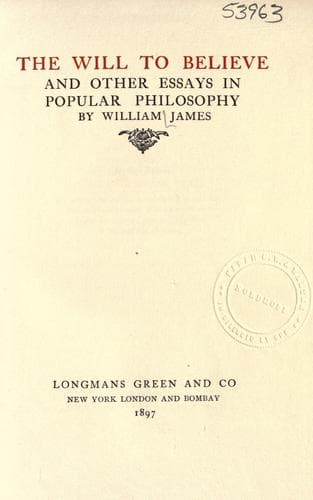
The Will to Believe, and Other Essays in Popular PhilosophyJames, William
Religion
The Will to Believe, and Other Essays in Popular Philosophy
James, William
Belief and doubt; Essays; Philosophy
To Professor Jevons is due the great credit of having emphatically
pointed out[16] how the genius of discovery depends altogether on the
number of these random notions and guesses which visit the
investigator's mind. To be fertile in hypotheses is the first
requisite, and to be willing to throw them away the moment experience
contradicts them is the next. The Baconian method of collating tables
of instances may be a useful aid at certain times. But one might as
well expect a chemist's note-book to write down the name of the body
analyzed, or a weather table to sum itself up into a prediction of
probabilities of its own accord, as to hope that the mere fact of
mental confrontation with a certain series of facts will be sufficient
to make _any_ brain conceive their law. The conceiving of the law is a
spontaneous variation in the strictest sense of the term. It flashes
out of one brain, and no other, because the instability of that brain
is such as to tip and upset itself in just that particular direction.
But the important thing to notice is that the good flashes and the bad
flashes, the triumphant hypotheses and the absurd conceits, are on an
exact equality in respect of their origin. Aristotle's absurd Physics
and his immortal Logic flow from one source: the forces that produce
the one produce the other. {250} When walking along the street,
thinking of the blue sky or the fine spring weather, I may either smile
at some grotesque whim which occurs to me, or I may suddenly catch an
intuition of the solution of a long-unsolved problem, which at that
moment was far from my thoughts. Both notions are shaken out of the
same reservoir,--the reservoir of a brain in which the reproduction of
images in the relations of their outward persistence or frequency has
long ceased to be the dominant law. But to the thought, when it is
once engendered, the consecration of agreement with outward relations
may come. The conceit perishes in a moment, and is forgotten. The
scientific hypothesis arouses in me a fever of desire for verification.
I read, write, experiment, consult experts. Everything corroborates my
notion, which being then published in a book spreads from review to
review and from mouth to mouth, till at last there is no doubt I am
enshrined in the Pantheon of the great diviners of nature's ways. The
environment _preserves_ the conception which it was unable to _produce_
in any brain less idiosyncratic than my own.
Public-domain text, read in full here on John Shaqi.
Reviews
Reviews
No reviews yet
Be the first to share your thoughts on this work.
Elsewhere in the archive
Join the Discussion
Join the discussion
Sign in to leave a comment or review.
Sign InorCreate an account