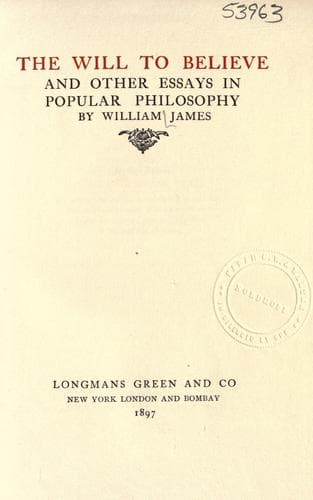
The Will to Believe, and Other Essays in Popular PhilosophyJames, William
Religion
The Will to Believe, and Other Essays in Popular Philosophy
James, William
Belief and doubt; Essays; Philosophy
NOTE.--Since the preceding article was written, some observations on
the effects of nitrous-oxide-gas-intoxication which I was prompted to
make by reading the pamphlet called The Anaesthetic Revelation and the
Gist of Philosophy, by Benjamin Paul Blood, Amsterdam, N. Y., 1874,
have made me understand better than ever before both the strength and
the weakness of Hegel's philosophy. I strongly urge others to repeat
the experiment, which with pure gas is short and harmless enough. The
effects will of course vary with the individual. Just as they vary in
the same individual from time to time; but it is probable that in the
former case, as in the latter, a generic resemblance will obtain. With
me, as with every other person of whom I have heard, the keynote of the
experience is the tremendously exciting sense of an intense
metaphysical illumination. Truth lies open to the view in depth
beneath depth of almost blinding evidence. The mind sees all the
logical relations of being with an apparent subtlety and instantaneity
to which its normal consciousness offers no parallel; only as sobriety
returns, the feeling of insight fades, and one is left staring vacantly
at a few disjointed words and phrases, as one stares at a
cadaverous-looking snow-peak from which the sunset glow has just fled,
or at the black cinder left by an extinguished brand.
{295}
The immense emotional sense of _reconciliation_ which characterizes the
'maudlin' stage of alcoholic drunkenness,--a stage which seems silly to
lookers-on, but the subjective rapture of which probably constitutes a
chief part of the temptation to the vice,--is well known. The centre
and periphery of things seem to come together. The ego and its
objects, the _meum_ and the _tuum_, are one. Now this, only a
thousandfold enhanced, was the effect upon me of the gas: and its first
result was to make peal through me with unutterable power the
conviction that Hegelism was true after all, and that the deepest
convictions of my intellect hitherto were wrong. Whatever idea or
representation occurred to the mind was seized by the same logical
forceps, and served to illustrate the same truth; and that truth was
that every opposition, among whatsoever things, vanishes in a higher
unity in which it is based; that all contradictions, so-called, are but
differences; that all differences are of degree; that all degrees are
of a common kind; that unbroken continuity is of the essence of being;
and that we are literally in the midst of _an infinite_, to perceive
the existence of which is the utmost we can attain. Without the _same_
as a basis, how could strife occur? Strife presupposes something to be
striven about; and in this common topic, the same for both parties, the
differences merge. From the hardest contradiction to the tenderest
diversity of verbiage differences evaporate; _yes_ and _no_ agree at
least in being assertions; a denial of a statement is but another mode
Public-domain text, read in full here on John Shaqi.
Reviews
Reviews
No reviews yet
Be the first to share your thoughts on this work.
Elsewhere in the archive
Join the Discussion
Join the discussion
Sign in to leave a comment or review.
Sign InorCreate an account