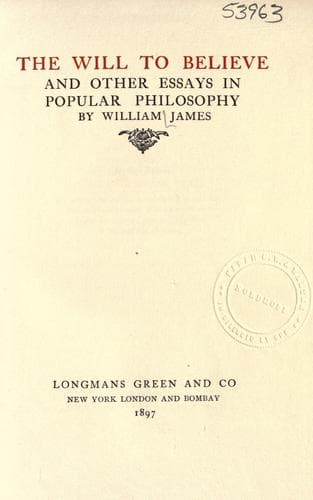
The Will to Believe, and Other Essays in Popular PhilosophyJames, William
Religion
The Will to Believe, and Other Essays in Popular Philosophy
James, William
Belief and doubt; Essays; Philosophy
[3] Not only for simplicity's sake do we select space as the paragon of
a rationalizing continuum. Space determines the relations of the items
that enter it in a far more intricate way than does time; in a far more
fixed way than does the ego. By this last clause I mean that if things
are in space at all, they must conform to geometry; while the being in
an ego at all need not make them conform to logic or any other manner
of rationality. Under the sheltering wings of a self the matter of
unreason can lodge itself as safely as any other kind of content. One
cannot but respect the devoutness of the ego-worship of some of our
English-writing Hegelians. But at the same time one cannot help
fearing lest the monotonous contemplation of so barren a principle as
that of the pure formal self (which, be it never so essential a
condition of the existence of a world of organized experience at all,
must notwithstanding take its own _character_ from, not give the
character to, the separate empirical data over which its mantle is
cast), one cannot but fear, I say, lest the religion of the
transcendental ego should, like all religions of the 'one thing
needful,' end by sterilizing and occluding the minds of its believers.
[4] Journal of Speculative Philosophy, viii. 37.
{299}
WHAT PSYCHICAL RESEARCH HAS ACCOMPLISHED.[1]
"The great field for new discoveries," said a scientific friend to me
the other day, "is always the unclassified residuum." Round about the
accredited and orderly facts of every science there ever floats a sort
of dust-cloud of exceptional observations, of occurrences minute and
irregular and seldom met with, which it always proves more easy to
ignore than to attend to. The ideal of every science is that of a
closed and completed system of truth. The charm of most sciences to
their more passive disciples consists in their appearing, in fact, to
wear just this ideal form. Each one of our various _ologies_ seems to
offer a definite head of classification for every possible phenomenon
of the sort which it professes to cover; and so far from free is most
men's fancy, that, when a consistent and organized scheme of this sort
has once been comprehended and assimilated, a different scheme is
unimaginable. No alternative, whether to whole or parts, can any
longer be conceived as possible. Phenomena unclassifiable within the
system are therefore paradoxical {300} absurdities, and must be held
untrue. When, moreover, as so often happens, the reports of them are
vague and indirect; when they come as mere marvels and oddities rather
than as things of serious moment,--one neglects or denies them with the
best of scientific consciences. Only the born geniuses let themselves
be worried and fascinated by these outstanding exceptions, and get no
peace till they are brought within the fold. Your Galileos, Galvanis,
Fresnels, Purkinjes, and Darwins are always getting confounded and
troubled by insignificant things.
Public-domain text, read in full here on John Shaqi.
Reviews
Reviews
No reviews yet
Be the first to share your thoughts on this work.
Elsewhere in the archive
Join the Discussion
Join the discussion
Sign in to leave a comment or review.
Sign InorCreate an account