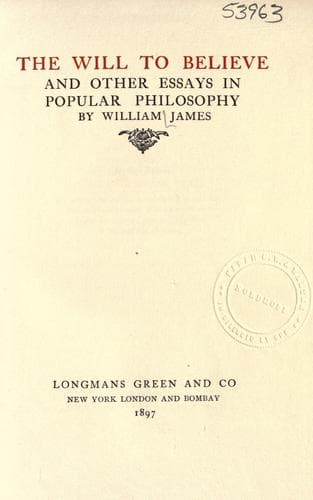
The Will to Believe, and Other Essays in Popular PhilosophyJames, William
Religion
The Will to Believe, and Other Essays in Popular Philosophy
James, William
Belief and doubt; Essays; Philosophy
But one cannot by mere outward organization make much progress in
matters scientific. Societies can {307} back men of genius, but can
never take their place. The contrast between the parent Society and
the American Branch illustrates this. In England, a little group of
men with enthusiasm and genius for the work supplied the nucleus; in
this country, Mr. Hodgson had to be imported from Europe before any
tangible progress was made. What perhaps more than anything else has
held the Society together in England is Professor Sidgwick's
extraordinary gift of inspiring confidence in diverse sorts of people.
Such tenacity of interest in the result and such absolute impartiality
in discussing the evidence are not once in a century found in an
individual. His obstinate belief that there is something yet to be
brought to light communicates patience to the discouraged; his
constitutional inability to draw any precipitate conclusion reassures
those who are afraid of being dupes. Mrs. Sidgwick--a sister, by the
way, of the great Arthur Balfour--is a worthy ally of her husband in
this matter, showing a similarly rare power of holding her judgment in
suspense, and a keenness of observation and capacity for experimenting
with human subjects which are rare in either sex.
The _worker_ of the Society, as originally constituted, was Edmund
Gurney. Gurney was a man of the rarest sympathies and gifts.
Although, like Carlyle, he used to groan under the burden of his
labors, he yet exhibited a colossal power of dispatching business and
getting through drudgery of the most repulsive kind. His two thick
volumes on 'Phantasms of the Living,' collected and published in three
years, are a proof of this. Besides this, he had exquisite artistic
instincts, and his massive volume on 'The Power of Sound' was, when it
appeared, the most important {308} work on aesthetics in the English
language. He had also the tenderest heart and a mind of rare
metaphysical power, as his volumes of essays, 'Tertium Quid,' will
prove to any reader. Mr. Frederic Myers, already well known as one of
the most brilliant of English essayists, is the _ingenium praefervidum_
of the S. P. R. Of the value of Mr. Myers's theoretic writings I will
say a word later. Dr. Hodgson, the American secretary, is
distinguished by a balance of mind almost as rare in its way as
Sidgwick's. He is persuaded of the reality of many of the phenomena
called spiritualistic, but he also has uncommon keenness in detecting
error; and it is impossible to say in advance whether it will give him
more satisfaction to confirm or to smash a given case offered to his
examination.
Public-domain text, read in full here on John Shaqi.
Reviews
Reviews
No reviews yet
Be the first to share your thoughts on this work.
Elsewhere in the archive
Join the Discussion
Join the discussion
Sign in to leave a comment or review.
Sign InorCreate an account