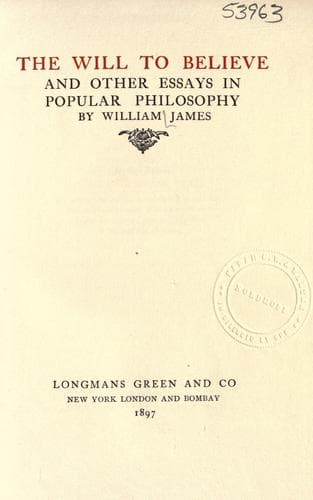
The Will to Believe, and Other Essays in Popular PhilosophyJames, William
Religion
The Will to Believe, and Other Essays in Popular Philosophy
James, William
Belief and doubt; Essays; Philosophy
[2] Quoted by George E. Waring in his book on Tyrol. Compare A.
Bérard: Les Vaudois, Lyon, Storck, 1892.
{63}
THE SENTIMENT OF RATIONALITY.[1]
I.
What is the task which philosophers set themselves to perform; and why
do they philosophize at all? Almost every one will immediately reply:
They desire to attain a conception of the frame of things which shall
on the whole be more rational than that somewhat chaotic view which
every one by nature carries about with him under his hat. But suppose
this rational conception attained, how is the philosopher to recognize
it for what it is, and not let it slip through ignorance? The only
answer can be that he will recognize its rationality as he recognizes
everything else, by certain subjective marks with which it affects him.
When he gets the marks, he may know that he has got the rationality.
What, then, are the marks? A strong feeling of ease, peace, rest, is
one of them. The transition from a state of puzzle and perplexity to
rational comprehension is full of lively relief and pleasure.
But this relief seems to be a negative rather than a positive
character. Shall we then say that the feeling of rationality is
constituted merely by the absence {64} of any feeling of irrationality?
I think there are very good grounds for upholding such a view. All
feeling whatever, in the light of certain recent psychological
speculations, seems to depend for its physical condition not on simple
discharge of nerve-currents, but on their discharge under arrest,
impediment, or resistance. Just as we feel no particular pleasure when
we breathe freely, but a very intense feeling of distress when the
respiratory motions are prevented,--so any unobstructed tendency to
action discharges itself without the production of much cogitative
accompaniment, and any perfectly fluent course of thought awakens but
little feeling; but when the movement is inhibited, or when the thought
meets with difficulties, we experience distress. It is only when the
distress is upon us that we can be said to strive, to crave, or to
aspire. When enjoying plenary freedom either in the way of motion or
of thought, we are in a sort of anaesthetic state in which we might say
with Walt Whitman, if we cared to say anything about ourselves at such
times, "I am sufficient as I am." This feeling of the sufficiency of
the present moment, of its absoluteness,--this absence of all need to
explain it, account for it, or justify it,--is what I call the
Sentiment of Rationality. As soon, in short, as we are enabled from
any cause whatever to think with perfect fluency, the thing we think of
seems to us _pro tanto_ rational.
Whatever modes of conceiving the cosmos facilitate this fluency,
produce the sentiment of rationality. Conceived in such modes, being
vouches for itself and needs no further philosophic formulation. But
this fluency may be obtained in various ways; and first I will take up
the theoretic way.
{65}
Public-domain text, read in full here on John Shaqi.
Reviews
Reviews
No reviews yet
Be the first to share your thoughts on this work.
Join the Discussion
Join the discussion
Sign in to leave a comment or review.
Sign InorCreate an account