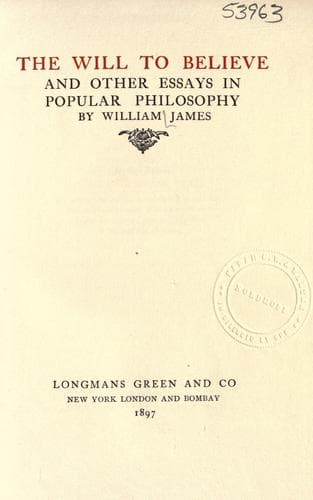
The Will to Believe, and Other Essays in Popular PhilosophyJames, William
Religion
The Will to Believe, and Other Essays in Popular Philosophy
James, William
Belief and doubt; Essays; Philosophy
The facts of the world in their sensible diversity are always before
us, but our theoretic need is that they should be conceived in a way
that reduces their manifoldness to simplicity. Our pleasure at finding
that a chaos of facts is the expression of a single underlying fact is
like the relief of the musician at resolving a confused mass of sound
into melodic or harmonic order. The simplified result is handled with
far less mental effort than the original data; and a philosophic
conception of nature is thus in no metaphorical sense a labor-saving
contrivance. The passion for parsimony, for economy of means in
thought, is the philosophic passion _par excellence_; and any character
or aspect of the world's phenomena which gathers up their diversity
into monotony will gratify that passion, and in the philosopher's mind
stand for that essence of things compared with which all their other
determinations may by him be overlooked.
More universality or extensiveness is, then, one mark which the
philosopher's conceptions must possess. Unless they apply to an
enormous number of cases they will not bring him relief. The knowledge
of things by their causes, which is often given as a definition of
rational knowledge, is useless to him unless the causes converge to a
minimum number, while still producing the maximum number of effects.
The more multiple then are the instances, the more flowingly does his
mind rove from fact to fact. The phenomenal transitions are no real
transitions; each item is the same old friend with a slightly altered
dress.
Who does not feel the charm of thinking that the moon and the apple
are, as far as their relation to the {66} earth goes, identical; of
knowing respiration and combustion to be one; of understanding that the
balloon rises by the same law whereby the stone sinks; of feeling that
the warmth in one's palm when one rubs one's sleeve is identical with
the motion which the friction checks; of recognizing the difference
between beast and fish to be only a higher degree of that between human
father and son; of believing our strength when we climb the mountain or
fell the tree to be no other than the strength of the sun's rays which
made the corn grow out of which we got our morning meal?
Public-domain text, read in full here on John Shaqi.
Reviews
Reviews
No reviews yet
Be the first to share your thoughts on this work.
Join the Discussion
Join the discussion
Sign in to leave a comment or review.
Sign InorCreate an account