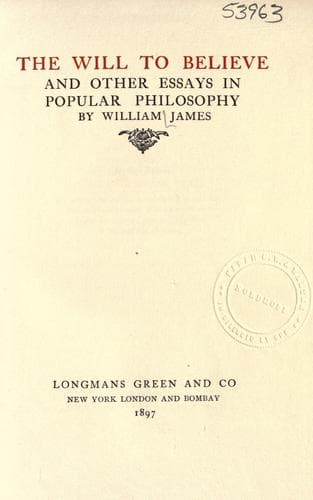
The Will to Believe, and Other Essays in Popular PhilosophyJames, William
Religion
The Will to Believe, and Other Essays in Popular Philosophy
James, William
Belief and doubt; Essays; Philosophy
But alongside of this passion for simplification there exists a sister
passion, which in some minds--though they perhaps form the minority--is
its rival. This is the passion for distinguishing; it is the impulse
to be _acquainted_ with the parts rather than to comprehend the whole.
Loyalty to clearness and integrity of perception, dislike of blurred
outlines, of vague identifications, are its characteristics. It loves
to recognize particulars in their full completeness, and the more of
these it can carry the happier it is. It prefers any amount of
incoherence, abruptness, and fragmentariness (so long as the literal
details of the separate facts are saved) to an abstract way of
conceiving things that, while it simplifies them, dissolves away at the
same time their concrete fulness. Clearness and simplicity thus set up
rival claims, and make a real dilemma for the thinker.
A man's philosophic attitude is determined by the balance in him of
these two cravings. No system of philosophy can hope to be universally
accepted among men which grossly violates either need, or {67} entirely
subordinates the one to the other. The fate of Spinosa, with his
barren union of all things in one substance, on the one hand; that of
Hume, with his equally barren 'looseness and separateness' of
everything, on the other,--neither philosopher owning any strict and
systematic disciples to-day, each being to posterity a warning as well
as a stimulus,--show us that the only possible philosophy must be a
compromise between an abstract monotony and a concrete heterogeneity.
But the only way to mediate between diversity and unity is to class the
diverse items as cases of a common essence which you discover in them.
Classification of things into extensive 'kinds' is thus the first step;
and classification of their relations and conduct into extensive 'laws'
is the last step, in their philosophic unification. A completed
theoretic philosophy can thus never be anything more than a completed
classification of the world's ingredients; and its results must always
be abstract, since the basis of every classification is the abstract
essence embedded in the living fact,--the rest of the living fact being
for the time ignored by the classifier. This means that none of our
explanations are complete. They subsume things under heads wider or
more familiar; but the last heads, whether of things or of their
connections, are mere abstract genera, data which we just find in
things and write down.
Public-domain text, read in full here on John Shaqi.
Reviews
Reviews
No reviews yet
Be the first to share your thoughts on this work.
Join the Discussion
Join the discussion
Sign in to leave a comment or review.
Sign InorCreate an account