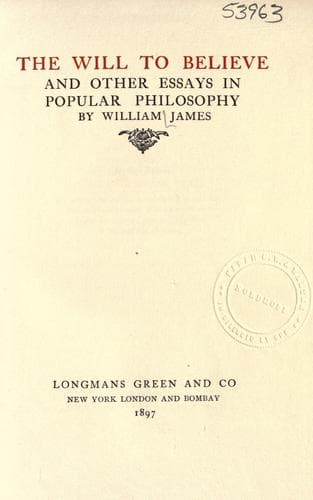
The Will to Believe, and Other Essays in Popular PhilosophyJames, William
Religion
The Will to Believe, and Other Essays in Popular Philosophy
James, William
Belief and doubt; Essays; Philosophy
But, unfortunately, this first answer will not hold. Our mind is so
wedded to the process of seeing an _other_ beside every item of its
experience, that when the notion of an absolute datum is presented to
it, it goes through its usual procedure and remains pointing at the
void beyond, as if in that lay further matter for contemplation. In
short, it spins for itself the further positive consideration of a
nonentity {72} enveloping the being of its datum; and as that leads
nowhere, back recoils the thought toward its datum again. But there is
no natural bridge between nonentity and this particular datum, and the
thought stands oscillating to and fro, wondering "Why was there
anything but nonentity; why just this universal datum and not another?"
and finds no end, in wandering mazes lost. Indeed, Bain's words are so
untrue that in reflecting men it is just when the attempt to fuse the
manifold into a single totality has been most successful, when the
conception of the universe as a unique fact is nearest its perfection,
that the craving for further explanation, the ontological
wonder-sickness, arises in its extremest form. As Schopenhauer says,
"The uneasiness which keeps the never-resting clock of metaphysics in
motion, is the consciousness that the non-existence of this world is
just as possible as its existence."
The notion of nonentity may thus be called the parent of the
philosophic craving in its subtilest and profoundest sense. Absolute
existence is absolute mystery, for its relations with the nothing
remain unmediated to our understanding. One philosopher only has
pretended to throw a logical bridge over this chasm. Hegel, by trying
to show that nonentity and concrete being are linked together by a
series of identities of a synthetic kind, binds everything conceivable
into a unity, with no outlying notion to disturb the free rotary
circulation of the mind within its bounds. Since such unchecked
movement gives the feeling of rationality, he must be held, if he has
succeeded, to have eternally and absolutely quenched all rational
demands.
Public-domain text, read in full here on John Shaqi.
Reviews
Reviews
No reviews yet
Be the first to share your thoughts on this work.
Elsewhere in the archive
Join the Discussion
Join the discussion
Sign in to leave a comment or review.
Sign InorCreate an account