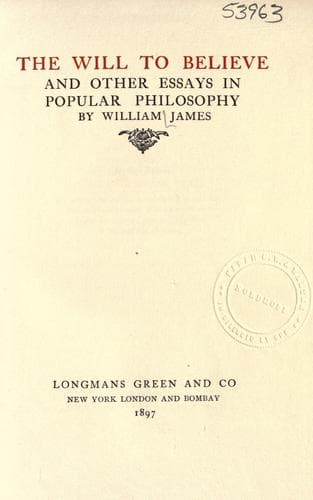
The Will to Believe, and Other Essays in Popular PhilosophyJames, William
Religion
The Will to Believe, and Other Essays in Popular Philosophy
James, William
Belief and doubt; Essays; Philosophy
But suppose the goal attained. Suppose that at last we have a system
unified in the sense that has been explained. Our world can now be
conceived simply, and our mind enjoys the relief. Our universal
concept has made the concrete chaos rational. But now I ask, Can that
which is the ground of rationality in all else be itself properly
called rational? It would seem at first sight that it might. One is
tempted at any rate to say that, since the craving for rationality is
appeased by the identification of one {71} thing with another, a datum
which left nothing else outstanding might quench that craving
definitively, or be rational _in se_. No otherness being left to annoy
us, we should sit down at peace. In other words, as the theoretic
tranquillity of the boor results from his spinning no further
considerations about his chaotic universe, so any datum whatever
(provided it were simple, clear, and ultimate) ought to banish puzzle
from the universe of the philosopher and confer peace, inasmuch as
there would then be for him absolutely no further considerations to
spin.
This in fact is what some persons think. Professor Bain says,--
"A difficulty is solved, a mystery unriddled, when it can be shown to
resemble something else; to be an example of a fact already known.
Mystery is isolation, exception, or it may be apparent contradiction:
the resolution of the mystery is found in assimilation, identity,
fraternity. When all things are assimilated, so far as assimilation
can go, so far as likeness holds, there is an end to explanation; there
is an end to what the mind can do, or can intelligently desire.... The
path of science as exhibited in modern ages is toward generality, wider
and wider, until we reach the highest, the widest laws of every
department of things; there explanation is finished, mystery ends,
perfect vision is gained."
Public-domain text, read in full here on John Shaqi.
Reviews
Reviews
No reviews yet
Be the first to share your thoughts on this work.
Join the Discussion
Join the discussion
Sign in to leave a comment or review.
Sign InorCreate an account