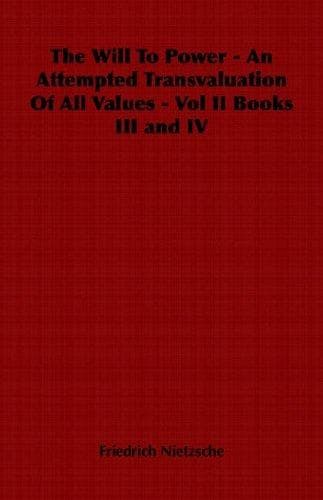
The Will to Power: An Attempted Transvaluation of All Values. Book III and IVNietzsche, Friedrich Wilhelm
PhilosophyPhilosophy
The Will to Power: An Attempted Transvaluation of All Values. Book III and IV
Nietzsche, Friedrich Wilhelm
Nihilism (Philosophy); Power (Philosophy); Values
_The order of rank:_ he who _determines_ values and leads the will of
millenniums, and does this by leading the highest natures--he _is the
highest man._
1000.
I fancy I have divined some of the things that lie hidden in the soul
of the highest man; perhaps every man who has divined so much must go
to ruin: but he who has seen the highest man must do all he can to
make him _possible._ Fundamental thought: we must make the future the
standard of all our valuations--and not seek the laws for our conduct
behind us.
1001.
Not "mankind," but _Superman_ is the goal!
1002.
"Come l'uom s'eterna...."--_Inf._ xv. 85.
II.
DIONYSUS.
1003.
To _him who is one of Nature's lucky strokes,_ to, him unto whom my
heart goes out, to him who is carved from one integral block, which is
hard, sweet, and fragrant--to him from whom even my nose can derive
some pleasure--let this book be dedicated.
He enjoys that which is beneficial to him.
His pleasure in anything ceases when the limits of what is beneficial
to him are overstepped.
He divines the remedies for partial injuries; his illnesses are the
great stimulants of his existence.
He understands how to exploit his serious accidents.
He grows stronger under the misfortunes which threaten to annihilate
him.
He instinctively gathers from all he sees, hears, and experiences,
the materials for what concerns him most,--he pursues a selective
principle,--he rejects a good deal.
He reacts with that tardiness which long caution and deliberate
_pride_ have bred in him,--he tests the stimulus: whence does it come?
whither does it lead? He does not submit.
He is always in his own company, whether his intercourse be with books,
with men, or with Nature.
He honours anything by choosing it, by conceding to it, by trusting it.
1004.
We should attain to such a height, to such a lofty eagle's ledge, in
our observation, as to be able to understand that everything happens,
_just as it ought to happen_: and that all "imperfection," and the pain
it brings, belong to all that which is most eminently desirable.
1005.
Towards 1876 I experienced a fright; for I saw that everything I had
most wished for up to that time was being compromised. I realised this
when I perceived what Wagner was actually driving at: and I was bound
very fast to him--by all the bonds of a profound similarity of needs,
by gratitude, by the thought that he could not be replaced, and by the
absolute void which I saw facing me.
Just about this time I believed myself to be inextricably entangled in
my philology and my professorship--in the accident and last shift of my
life: I did not know how to get out of it, and was tired, used up, and
on my last legs.
Public-domain text, read in full here on John Shaqi.
Reviews
Reviews
No reviews yet
Be the first to share your thoughts on this work.
Elsewhere in the archive
Join the Discussion
Join the discussion
Sign in to leave a comment or review.
Sign InorCreate an account